Mycorrhizal Associations in Cannabis and Hemp
Explain arbuscular mycorrhizal symbiosis, distinguish colonization from benefit, and set evidence-aware expectations for inoculation.
Explain arbuscular mycorrhizal symbiosis, distinguish colonization from benefit, and set evidence-aware expectations for inoculation.
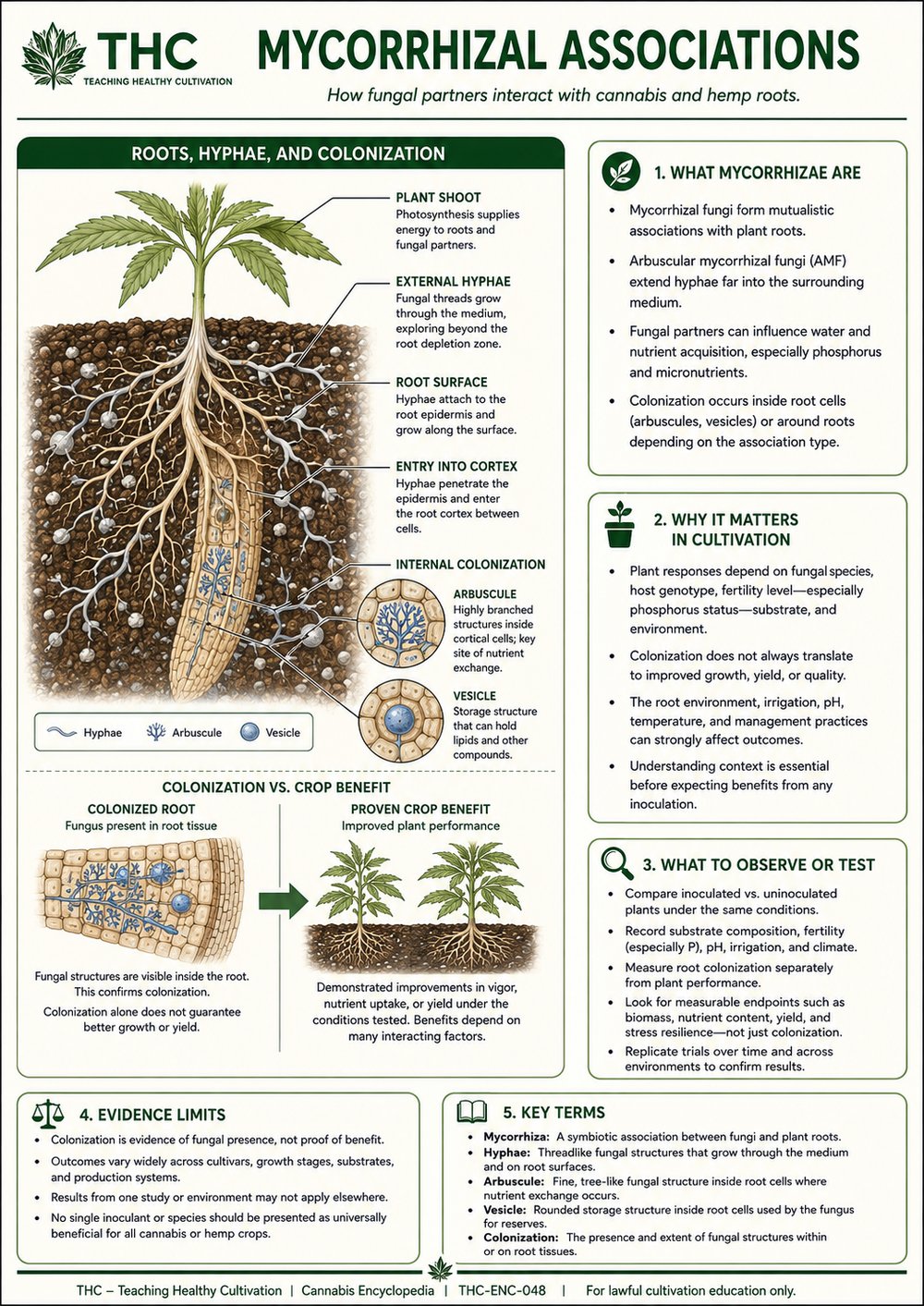
Core science
Cannabis can form arbuscular mycorrhizal associations. The plant supplies carbon; fungal hyphae explore pore spaces and can transfer nutrients, especially phosphorus, and sometimes influence water relations and stress responses. The exchange is regulated and carries a carbon cost.
A hemp experiment with one cultivar and two fungal species reported treatment-specific increases in growth and cannabinoid outcomes relative to its controls. That supports biological possibility, not a universal promise. Fungal identity, cultivar, fertility, substrate, duration, and control design constrain interpretation.
High available phosphorus can reduce the plant’s incentive to support colonization, while sterilized or inert systems may lack an established network. Fungicides, sanitation, transplant handling, and irrigation can affect viability. A label listing spores does not prove those propagules reached roots or formed arbuscules.
Why this matters in cultivation
- Place viable inoculum where new roots will contact it and keep the system compatible with the organism’s label. Record base phosphorus and avoid crediting the inoculant for fertility differences.
- For a serious trial, verify root colonization microscopically or by a qualified laboratory and measure both plant performance and input cost.
Measure and record
Inoculum
Species or consortium, propagule concentration, lot, expiry, and storage.
Application
Rate, root-contact location, timing, and carrier.
Root zone
Media, pH, EC, phosphorus program, moisture, and pesticide exposures.
Colonization
Sampling date, staining or test method, and percent or categorical result.
Response
Root/shoot biomass, nutrition, water response, yield, and chemistry with controls.
Common misconceptions
Misconception: Mycorrhizae replace fertilizer
Correction: They can change nutrient acquisition but do not create elements.
Misconception: Spores in the product prove colonization
Correction: Contact, viability, compatibility, and root confirmation are still required.
Misconception: A positive hemp study guarantees the same result in every cultivar
Correction: Responses are fungus-, genotype-, fertility-, and system-dependent.
Evidence limits and uncertainty
Cannabis-specific AMF trials use limited genotypes and conditions. Product comparisons, production-scale replication, and persistence data remain incomplete.
Check your reasoning
- For "Mycorrhizal Associations in Cannabis and Hemp", explain the mechanism behind this objective: Explain arbuscular mycorrhizal symbiosis, distinguish colonization from benefit, and set evidence-aware expectations for inoculation. Which observation or measurement would best test whether that mechanism is operating in the real crop?
- A learner claims, "Mycorrhizae replace fertilizer" Use the lesson’s science and evidence limits to explain why that claim is unreliable, then name one observation or measurement that could separate the competing explanations.
- Applied case — Place viable inoculum where new roots will contact it and keep the system compatible with the organism’s label. Record base phosphorus and avoid crediting the inoculant for fertility differences. Build a verification plan using the lesson’s record set (Inoculum, Application, Root zone). What would you compare before and after the action, and what result would make you revise the original interpretation?
Require lesson-specific evidence, not memorized universal targets. Open the rationales after you have written or discussed your own answer.
Answer rationale 1: Mechanism / workflow rationale
- A strong answer should connect the response to the lesson objective: Explain arbuscular mycorrhizal symbiosis, distinguish colonization from benefit, and set evidence-aware expectations for inoculation.
- Cannabis can form arbuscular mycorrhizal associations. The plant supplies carbon; fungal hyphae explore pore spaces and can transfer nutrients, especially phosphorus, and sometimes influence water relations and stress responses. The exchange is regulated and carries a carbon cost.
- A hemp experiment with one cultivar and two fungal species reported treatment-specific increases in growth and cannabinoid outcomes relative to its controls. That supports biological possibility, not a universal promise. Fungal identity, cultivar, fertility, substrate, duration, and control design constrain interpretation.
- The most useful verification evidence includes Inoculum: Species or consortium, propagule concentration, lot, expiry, and storage.
- Keep this limit explicit: Cannabis-specific AMF trials use limited genotypes and conditions. Product comparisons, production-scale replication, and persistence data remain incomplete.
Answer rationale 2: Misconception rationale
- The shortcut is unreliable because the lesson explicitly teaches a more conditional explanation.
- Representative misconception: Mycorrhizae replace fertilizer: They can change nutrient acquisition but do not create elements.
- Cannabis can form arbuscular mycorrhizal associations. The plant supplies carbon; fungal hyphae explore pore spaces and can transfer nutrients, especially phosphorus, and sometimes influence water relations and stress responses. The exchange is regulated and carries a carbon cost.
- A useful discriminator is Application: Rate, root-contact location, timing, and carrier.
- Do not overextend the conclusion beyond this limit: Cannabis-specific AMF trials use limited genotypes and conditions. Product comparisons, production-scale replication, and persistence data remain incomplete.
Answer rationale 3: Applied verification rationale
- In practice: Place viable inoculum where new roots will contact it and keep the system compatible with the organism’s label. Record base phosphorus and avoid crediting the inoculant for fertility differences.
- Record before action: Inoculum: Species or consortium, propagule concentration, lot, expiry, and storage.
- Also record: Application: Rate, root-contact location, timing, and carrier.
- After the action, repeat the same measurement or observation so the comparison is valid.
- Revise the interpretation if the result conflicts with the lesson limit or the expected response: Cannabis-specific AMF trials use limited genotypes and conditions. Product comparisons, production-scale replication, and persistence data remain incomplete.
Related lessons
Sources and evidence
- Seemakram W, et al. Enhancement of growth and cannabinoids content of hemp (Cannabis sativa) using arbuscular mycorrhizal fungi. Frontiers in Plant Science. 2022;13:845794. doi:10.3389/fpls.2022.845794. Open source
- Ahmed B, Hijri M. Potential impacts of soil microbiota manipulation on secondary metabolites production in cannabis. Journal of Cannabis Research. 2021;3:25. doi:10.1186/s42238-021-00082-0. Open source
- THC – Teaching Healthy Cultivation. Cannabis Plant Science Source Packet, version 1. Project source packet supplied by the publisher.
- Javot H, Pumplin N, Harrison MJ. Phosphate in the arbuscular mycorrhizal symbiosis: transport properties and regulatory roles. Plant, Cell & Environment. 2007;30(3):310–322. doi:10.1111/j.1365-3040.2006.01617.x. Open source
- Treseder KK. The extent of mycorrhizal colonization of roots and its influence on plant growth and phosphorus content. Plant and Soil. 2013;371:1–13. doi:10.1007/s11104-013-1681-5. Open source
Downloads
No lesson-specific download is approved for this release. Use browser print/save-to-PDF when you need an offline reading copy.