Cation Exchange Capacity and Nutrient Buffering
Interpret cation exchange capacity as one part of root-zone buffering and avoid using it as a stand-alone fertility score.
Interpret cation exchange capacity as one part of root-zone buffering and avoid using it as a stand-alone fertility score.
Core science
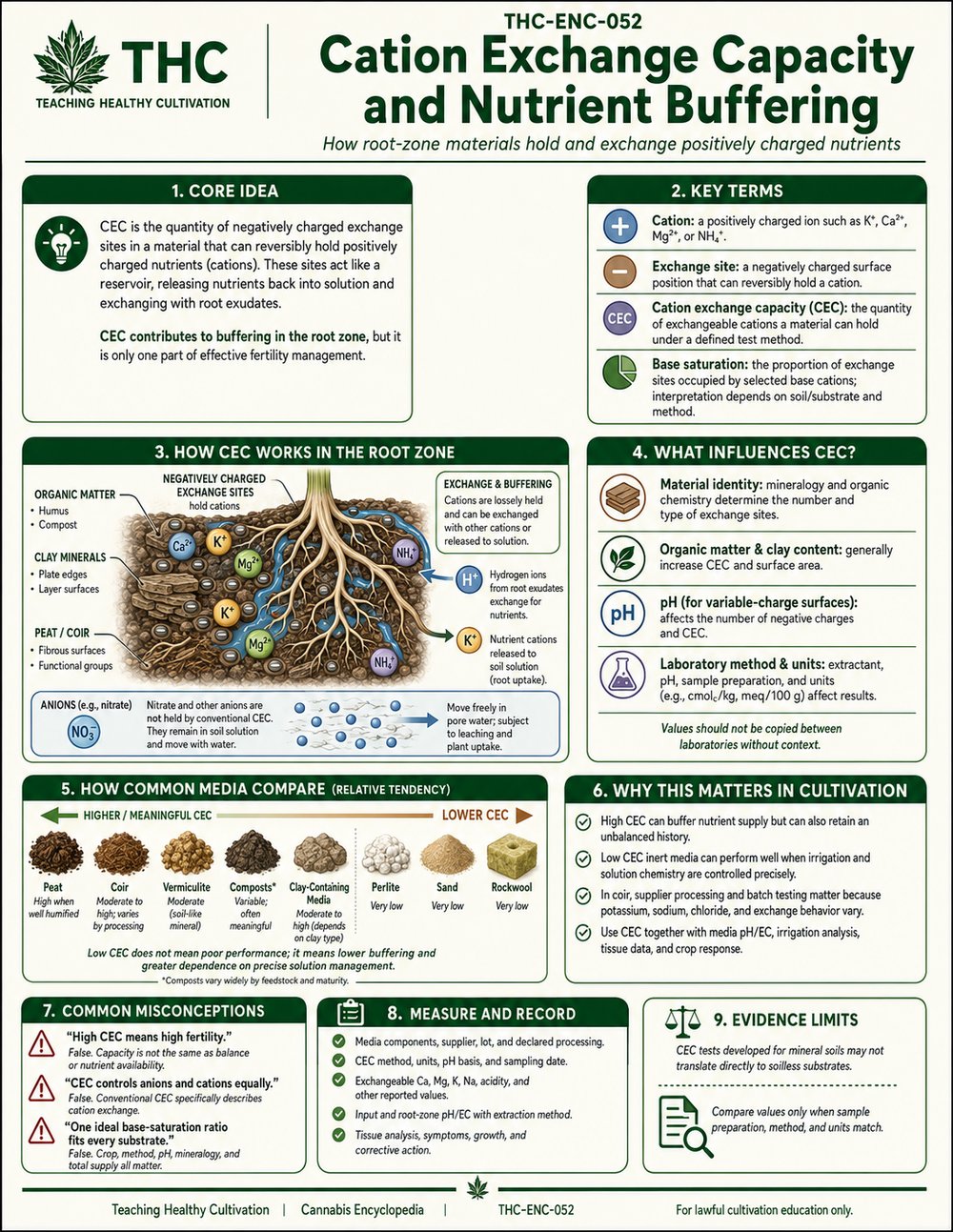
Clay minerals and organic materials carry surface charges that can attract and exchange cations. CEC influences how strongly a root zone buffers changes in potassium, calcium, magnesium, ammonium, and other positively charged nutrients. It does not directly hold anions such as nitrate in the same way.
CEC depends on material identity and, for variable-charge surfaces, pH. Peat, coir, vermiculite, clay, and many composts can have meaningful exchange capacity; perlite, sand, and rockwool have relatively little. Reported values are method-dependent and should not be copied between laboratories without context.
A high-CEC medium can buffer supply but can also retain an unbalanced history. A low-CEC inert medium can perform well when solution composition and irrigation are controlled precisely. Buffering changes the management strategy; it does not rank one system as universally superior.
Why this matters in cultivation
- In coir, initial potassium, sodium, and chloride plus exchange behavior make supplier processing and batch testing important. Do not assume every washed or buffered claim has the same analytical meaning.
- Use media pH/EC, irrigation analysis, tissue data, and input history alongside CEC. A percentage ratio is not a substitute for crop response and total concentration.
Measure and record
Material
Media components, supplier, lot, and declared processing.
Laboratory method
CEC method, units, pH basis, and sampling date.
Exchangeable ions
Ca, Mg, K, Na, acidity, and other reported values.
Solution data
Input and root-zone pH/EC with extraction method.
Crop response
Tissue analysis, symptoms, growth, and corrective action.
Common misconceptions
Misconception: High CEC means high fertility
Correction: Capacity is not the same as balanced occupancy or plant availability.
Misconception: CEC controls anions and cations equally
Correction: Conventional CEC specifically describes cation exchange.
Misconception: One ideal base-saturation ratio fits every substrate
Correction: Crop, method, mineralogy, pH, and total supply matter.
Evidence limits and uncertainty
CEC tests developed for mineral soils may not translate directly to soilless substrates. Compare values only when sample preparation, method, and units match.
Check your reasoning
- For "Cation Exchange Capacity and Nutrient Buffering", explain the mechanism behind this objective: Interpret cation exchange capacity as one part of root-zone buffering and avoid using it as a stand-alone fertility score. Which observation or measurement would best test whether that mechanism is operating in the real crop?
- A learner claims, "High CEC means high fertility" Use the lesson’s science and evidence limits to explain why that claim is unreliable, then name one observation or measurement that could separate the competing explanations.
- Applied case — In coir, initial potassium, sodium, and chloride plus exchange behavior make supplier processing and batch testing important. Do not assume every washed or buffered claim has the same analytical meaning. Build a verification plan using the lesson’s record set (Material, Laboratory method, Exchangeable ions). What would you compare before and after the action, and what result would make you revise the original interpretation?
Require lesson-specific evidence, not memorized universal targets. Open the rationales after you have written or discussed your own answer.
Answer rationale 1: Mechanism / workflow rationale
- A strong answer should connect the response to the lesson objective: Interpret cation exchange capacity as one part of root-zone buffering and avoid using it as a stand-alone fertility score.
- Clay minerals and organic materials carry surface charges that can attract and exchange cations. CEC influences how strongly a root zone buffers changes in potassium, calcium, magnesium, ammonium, and other positively charged nutrients. It does not directly hold anions such as nitrate in the same way.
- CEC depends on material identity and, for variable-charge surfaces, pH. Peat, coir, vermiculite, clay, and many composts can have meaningful exchange capacity; perlite, sand, and rockwool have relatively little. Reported values are method-dependent and should not be copied between laboratories without context.
- The most useful verification evidence includes Material: Media components, supplier, lot, and declared processing.
- Keep this limit explicit: CEC tests developed for mineral soils may not translate directly to soilless substrates. Compare values only when sample preparation, method, and units match.
Answer rationale 2: Misconception rationale
- The shortcut is unreliable because the lesson explicitly teaches a more conditional explanation.
- Representative misconception: High CEC means high fertility: Capacity is not the same as balanced occupancy or plant availability.
- Clay minerals and organic materials carry surface charges that can attract and exchange cations. CEC influences how strongly a root zone buffers changes in potassium, calcium, magnesium, ammonium, and other positively charged nutrients. It does not directly hold anions such as nitrate in the same way.
- A useful discriminator is Laboratory method: CEC method, units, pH basis, and sampling date.
- Do not overextend the conclusion beyond this limit: CEC tests developed for mineral soils may not translate directly to soilless substrates. Compare values only when sample preparation, method, and units match.
Answer rationale 3: Applied verification rationale
- In practice: In coir, initial potassium, sodium, and chloride plus exchange behavior make supplier processing and batch testing important. Do not assume every washed or buffered claim has the same analytical meaning.
- Record before action: Material: Media components, supplier, lot, and declared processing.
- Also record: Laboratory method: CEC method, units, pH basis, and sampling date.
- After the action, repeat the same measurement or observation so the comparison is valid.
- Revise the interpretation if the result conflicts with the lesson limit or the expected response: CEC tests developed for mineral soils may not translate directly to soilless substrates. Compare values only when sample preparation, method, and units match.
Related lessons
Sources and evidence
- Owen WG, Lopez RG. Commercial Greenhouse and Nursery Production: Evaluating Container Substrates and Their Components. Purdue Extension HO-255-W. 2015. Open source
- THC – Teaching Healthy Cultivation. Cannabis Plant Science Source Packet, version 1. Project source packet supplied by the publisher.
- Burgel L, Hartung J, Graeff-Hönninger S. Impact of Different Growing Substrates on Growth, Yield and Cannabinoid Content of Two Cannabis sativa L. Genotypes in a Pot Culture. Horticulturae. 2020;6(4):62. doi:10.3390/horticulturae6040062. See the 2022 correction: doi:10.3390/horticulturae8040298. Open source
- Mengel DB. Fundamentals of Soil Cation Exchange Capacity (CEC). Purdue University Cooperative Extension Service AY-238. Open source
Downloads
No lesson-specific download is approved for this release. Use browser print/save-to-PDF when you need an offline reading copy.