Rhizosphere Microbes: Functions and Limits of Claims
Classify root-associated microbial functions and evaluate microbial product claims using identity, context, controls, and measured outcomes.
Classify root-associated microbial functions and evaluate microbial product claims using identity, context, controls, and measured outcomes.
Core science
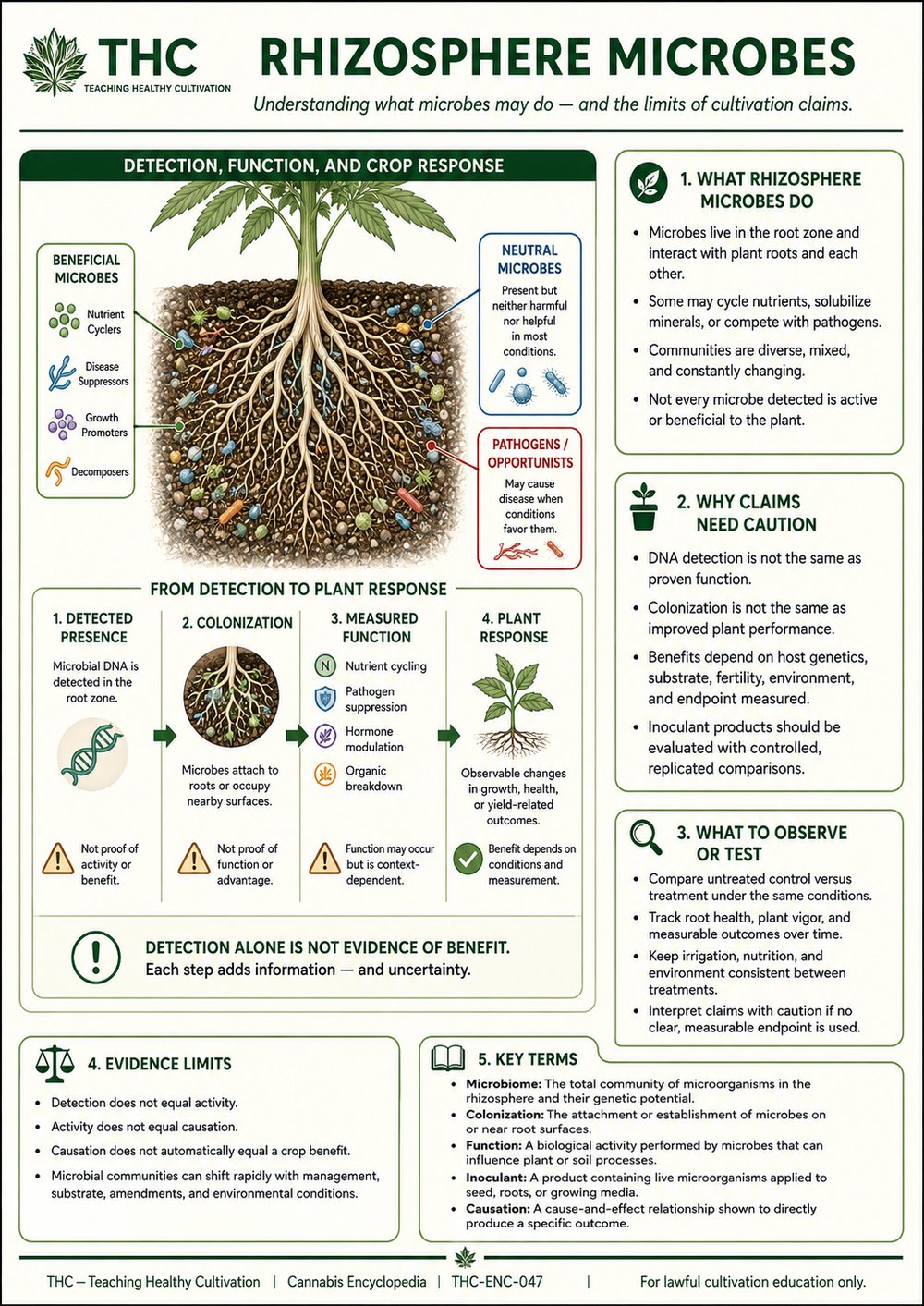
Root-associated communities contain bacteria, fungi, archaea, protists, viruses, and other organisms. Their functions can include decomposition, nutrient transformations, hormone-like signaling, competition, induced defense, disease, or no detectable effect. Taxonomic presence does not prove a particular function.
A controlled commercial study of three cannabis chemotypes found microbiome differences by compartment, crop age, and cultivar. This demonstrates structure and variation; it does not establish that every detected taxon improves growth or chemistry. Sequencing also measures relative DNA signatures, not automatically live activity or causation.
Inoculant performance depends on viable organism identity, dose, formulation, storage, application, compatibility with fertilizers and pesticides, temperature, pH, moisture, resident community, genotype, and endpoint. A product can fail to establish, establish without benefit, or alter outcomes only under specific conditions.
Why this matters in cultivation
- Treat microbials like testable production inputs. Preserve the label and lot, verify storage, apply to a defined group, and compare against an appropriate control under the same base fertility.
- Do not combine several new biological products in one trial. The result becomes uninterpretable and contamination risk increases.
Measure and record
Product identity
Named organism(s), strain when provided, concentration, lot, expiry, and storage.
Application
Rate, carrier, timing, location, water quality, and compatibility events.
Baseline
Media batch, fertility, plant genotype, existing disease, and prior biological inputs.
Establishment
Colonization or laboratory confirmation if the claim requires it.
Outcome
Rooting, biomass, nutrient status, disease, yield, chemistry, and economics.
Common misconceptions
Misconception: More diversity is always better
Correction: Community composition and function matter; diversity alone is not a performance guarantee.
Misconception: A detected microbe caused the observed trait
Correction: Association is not causation.
Misconception: Beneficial microbes cannot become contamination
Correction: Misidentified, contaminated, or misplaced organisms can create risk.
Evidence limits and uncertainty
Cannabis microbiome research is expanding but remains small relative to model crops. Many commercial formulations lack independently replicated cannabis trials.
Check your reasoning
- For "Rhizosphere Microbes: Functions and Limits of Claims", explain the mechanism behind this objective: Classify root-associated microbial functions and evaluate microbial product claims using identity, context, controls, and measured outcomes. Which observation or measurement would best test whether that mechanism is operating in the real crop?
- A learner claims, "More diversity is always better" Use the lesson’s science and evidence limits to explain why that claim is unreliable, then name one observation or measurement that could separate the competing explanations.
- Applied case — Treat microbials like testable production inputs. Preserve the label and lot, verify storage, apply to a defined group, and compare against an appropriate control under the same base fertility. Build a verification plan using the lesson’s record set (Product identity, Application, Baseline). What would you compare before and after the action, and what result would make you revise the original interpretation?
Require lesson-specific evidence, not memorized universal targets. Open the rationales after you have written or discussed your own answer.
Answer rationale 1: Mechanism / workflow rationale
- A strong answer should connect the response to the lesson objective: Classify root-associated microbial functions and evaluate microbial product claims using identity, context, controls, and measured outcomes.
- Root-associated communities contain bacteria, fungi, archaea, protists, viruses, and other organisms. Their functions can include decomposition, nutrient transformations, hormone-like signaling, competition, induced defense, disease, or no detectable effect. Taxonomic presence does not prove a particular function.
- A controlled commercial study of three cannabis chemotypes found microbiome differences by compartment, crop age, and cultivar. This demonstrates structure and variation; it does not establish that every detected taxon improves growth or chemistry. Sequencing also measures relative DNA signatures, not automatically live activity or causation.
- The most useful verification evidence includes Product identity: Named organism(s), strain when provided, concentration, lot, expiry, and storage.
- Keep this limit explicit: Cannabis microbiome research is expanding but remains small relative to model crops. Many commercial formulations lack independently replicated cannabis trials.
Answer rationale 2: Misconception rationale
- The shortcut is unreliable because the lesson explicitly teaches a more conditional explanation.
- Representative misconception: More diversity is always better: Community composition and function matter; diversity alone is not a performance guarantee.
- Root-associated communities contain bacteria, fungi, archaea, protists, viruses, and other organisms. Their functions can include decomposition, nutrient transformations, hormone-like signaling, competition, induced defense, disease, or no detectable effect. Taxonomic presence does not prove a particular function.
- A useful discriminator is Application: Rate, carrier, timing, location, water quality, and compatibility events.
- Do not overextend the conclusion beyond this limit: Cannabis microbiome research is expanding but remains small relative to model crops. Many commercial formulations lack independently replicated cannabis trials.
Answer rationale 3: Applied verification rationale
- In practice: Treat microbials like testable production inputs. Preserve the label and lot, verify storage, apply to a defined group, and compare against an appropriate control under the same base fertility.
- Record before action: Product identity: Named organism(s), strain when provided, concentration, lot, expiry, and storage.
- Also record: Application: Rate, carrier, timing, location, water quality, and compatibility events.
- After the action, repeat the same measurement or observation so the comparison is valid.
- Revise the interpretation if the result conflicts with the lesson limit or the expected response: Cannabis microbiome research is expanding but remains small relative to model crops. Many commercial formulations lack independently replicated cannabis trials.
Related lessons
Sources and evidence
- Comeau D, et al. Spatio-Temporal and Cultivar-Dependent Variations in the Cannabis Microbiome. Frontiers in Microbiology. 2020;11:491. doi:10.3389/fmicb.2020.00491. Open source
- Ahmed B, Hijri M. Potential impacts of soil microbiota manipulation on secondary metabolites production in cannabis. Journal of Cannabis Research. 2021;3:25. doi:10.1186/s42238-021-00082-0. Open source
- THC – Teaching Healthy Cultivation. Cannabis Plant Science Source Packet, version 1. Project source packet supplied by the publisher.
Downloads
No lesson-specific download is approved for this release. Use browser print/save-to-PDF when you need an offline reading copy.