Compost, Living Soil, and Biological Variability
Evaluate compost and biologically managed soil as variable ecosystems requiring chemical, physical, biological, and contamination controls.
Evaluate compost and biologically managed soil as variable ecosystems requiring chemical, physical, biological, and contamination controls.
Core science
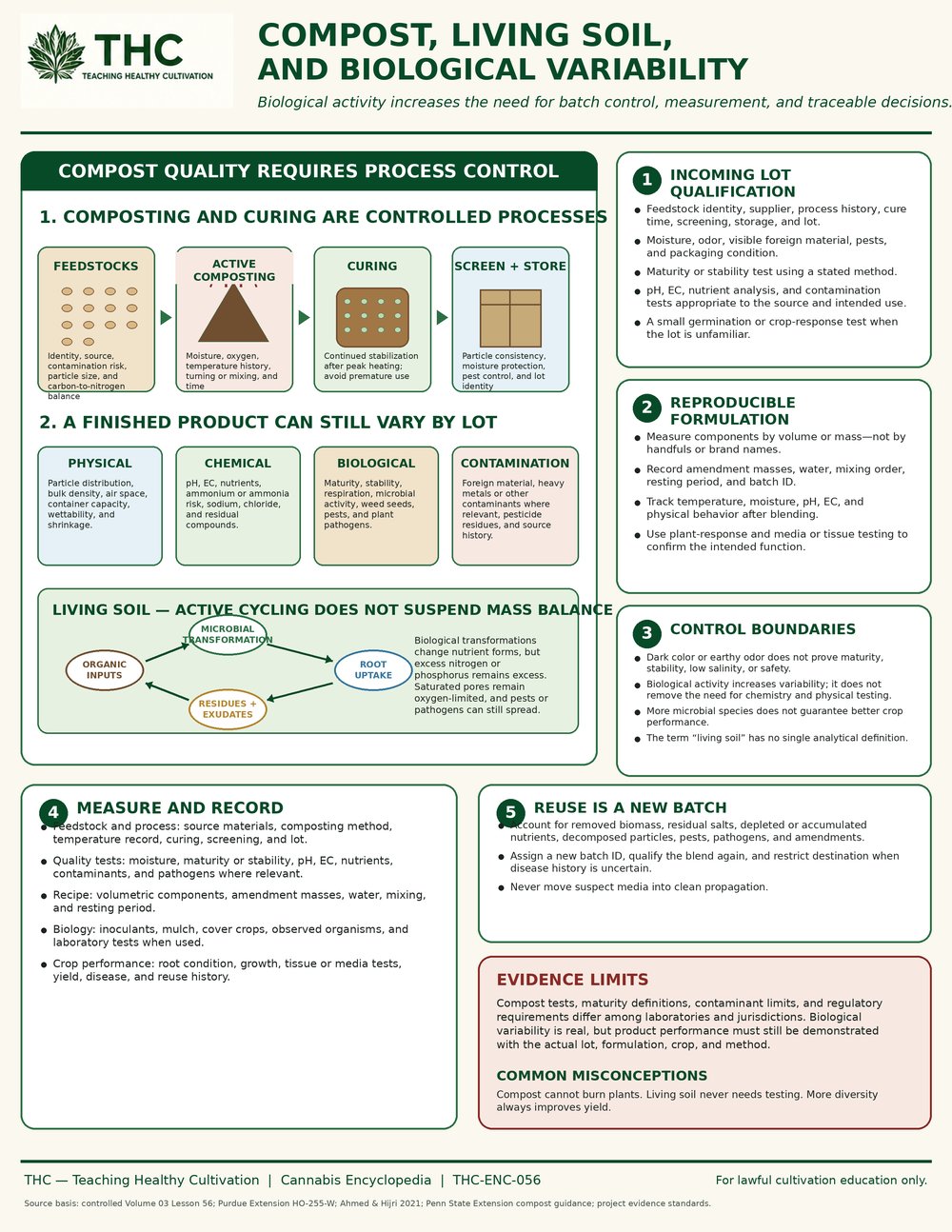
Compost quality depends on feedstocks, carbon-to-nitrogen balance, temperature history, moisture, aeration, turning, curing, screening, and storage. Finished products can contribute nutrients, organic matter, microbes, and water-holding capacity, but can also carry salts, immature compounds, contaminants, weed seeds, or plant pathogens.
Living-soil systems combine mineral particles, organic matter, amendments, roots, and organisms. Nutrients move through both solution chemistry and biological transformations. The label does not suspend mass balance: excess nitrogen or phosphorus remains excess, and saturated pores remain oxygen-limited.
Biological variability makes replication and batch control more important. A recipe measured by handfuls or brand names is not reproducible. Volumetric formulation, material analysis, temperature, moisture, pH, EC, and crop response should be recorded.
Decomposition and mineralization occur at rates influenced by moisture, temperature, oxygen availability, substrate composition, and microbial activity. A laboratory result for total nutrient content therefore does not indicate how much nitrogen will become plant-available within a particular crop interval. Immature compost can also create short-term oxygen demand or phytotoxicity, whereas high soluble salts may harm roots even if the material appears biologically active. Useful comparisons pair documented amendment rates and batch identifiers with standardized germination or plant-response tests; one healthy-looking plant or an earthy smell is not a substitute for representative sampling and relevant contaminant testing.
Why this matters in cultivation
- Start with a smaller verified compost proportion and use plant-response or germination tests when a lot is unfamiliar. Do not assume dark color or earthy odor proves maturity.
- If a living medium is reused, treat it as a new batch: account for removed biomass, residual salts, nutrient depletion or accumulation, pests, pathogens, structure, and amendments.
- Before incorporating a new compost batch, compare its reported soluble salt and maturity indicators with a known acceptable batch using the same test methods. Observe emergence or early root growth in replicated small test units alongside an unamended comparison. Keep amendment proportion, particle-size mixture, irrigation, and environmental conditions recorded so later differences can be interpreted without mistaking several simultaneous changes for a compost-specific effect.
Measure and record
Feedstock/process
Source materials, composting method, temperature record, curing, and lot.
Quality tests
Moisture, maturity/stability, pH, EC, nutrients, contaminants, and pathogens where relevant.
Recipe
Volumetric components, amendment masses, water, mixing, and resting period.
Biology
Inoculants, cover crops, mulch, observed organisms, and laboratory tests if used.
Crop performance
Root condition, growth, tissue/media tests, yield, disease, and reuse history.
Comparative evidence protocol
For each sample, label the collection location, depth, batch, and date; store the sample according to the testing laboratory’s directions. When monitoring compost processing, compare temperature measurements at multiple locations and record moisture and turning history, since a single warm probe position does not document uniform processing or sanitation.
Common misconceptions
Misconception: Compost cannot burn plants
Correction: Immaturity, ammonia, salts, or excessive nutrients can injure roots.
Misconception: Living soil never needs testing
Correction: Biological activity increases the need to understand changing chemistry and structure.
Misconception: More microbial species guarantees better yield
Correction: Function, context, competition, and crop response matter.
Evidence limits and uncertainty
The term living soil has no single analytical definition. Compost tests and regulatory contaminant limits vary by laboratory and jurisdiction.
Microbial activity, total nutrient content, and practical nutrient release are different measurements. A positive microbial assay is not evidence of a particular nutrient-delivery rate or a cannabis yield benefit. Apparent plant response may be confounded by soluble salts, water retention, nitrogen immobilization, cultivar, and environmental differences.
Check your reasoning
- For "Compost, Living Soil, and Biological Variability", explain the mechanism behind this objective: Evaluate compost and biologically managed soil as variable ecosystems requiring chemical, physical, biological, and contamination controls. Which observation or measurement would best test whether that mechanism is operating in the real crop?
- A learner claims, "Compost cannot burn plants" Use the lesson’s science and evidence limits to explain why that claim is unreliable, then name one observation or measurement that could separate the competing explanations.
- Applied case — Start with a smaller verified compost proportion and use plant-response or germination tests when a lot is unfamiliar. Do not assume dark color or earthy odor proves maturity. Build a verification plan using the lesson’s record set (Feedstock/process, Quality tests, Recipe). What would you compare before and after the action, and what result would make you revise the original interpretation?
Require lesson-specific evidence, not memorized universal targets. Open the rationales after you have written or discussed your own answer.
Answer rationale 1: Mechanism / workflow rationale
- A strong answer should connect the response to the lesson objective: Evaluate compost and biologically managed soil as variable ecosystems requiring chemical, physical, biological, and contamination controls.
- Compost quality depends on feedstocks, carbon-to-nitrogen balance, temperature history, moisture, aeration, turning, curing, screening, and storage. Finished products can contribute nutrients, organic matter, microbes, and water-holding capacity, but can also carry salts, immature compounds, contaminants, weed seeds, or plant pathogens.
- Living-soil systems combine mineral particles, organic matter, amendments, roots, and organisms. Nutrients move through both solution chemistry and biological transformations. The label does not suspend mass balance: excess nitrogen or phosphorus remains excess, and saturated pores remain oxygen-limited.
- The most useful verification evidence includes Feedstock/process: Source materials, composting method, temperature record, curing, and lot.
- Keep this limit explicit: The term living soil has no single analytical definition. Compost tests and regulatory contaminant limits vary by laboratory and jurisdiction.
Answer rationale 2: Misconception rationale
- The shortcut is unreliable because the lesson explicitly teaches a more conditional explanation.
- Representative misconception: Compost cannot burn plants: Immaturity, ammonia, salts, or excessive nutrients can injure roots.
- Compost quality depends on feedstocks, carbon-to-nitrogen balance, temperature history, moisture, aeration, turning, curing, screening, and storage. Finished products can contribute nutrients, organic matter, microbes, and water-holding capacity, but can also carry salts, immature compounds, contaminants, weed seeds, or plant pathogens.
- A useful discriminator is Quality tests: Moisture, maturity/stability, pH, EC, nutrients, contaminants, and pathogens where relevant.
- Do not overextend the conclusion beyond this limit: The term living soil has no single analytical definition. Compost tests and regulatory contaminant limits vary by laboratory and jurisdiction.
Answer rationale 3: Applied verification rationale
- In practice: Start with a smaller verified compost proportion and use plant-response or germination tests when a lot is unfamiliar. Do not assume dark color or earthy odor proves maturity.
- Record before action: Feedstock/process: Source materials, composting method, temperature record, curing, and lot.
- Also record: Quality tests: Moisture, maturity/stability, pH, EC, nutrients, contaminants, and pathogens where relevant.
- After the action, repeat the same measurement or observation so the comparison is valid.
- Revise the interpretation if the result conflicts with the lesson limit or the expected response: The term living soil has no single analytical definition. Compost tests and regulatory contaminant limits vary by laboratory and jurisdiction.
Related lessons
Sources and evidence
- Owen WG, Lopez RG. Commercial Greenhouse and Nursery Production: Evaluating Container Substrates and Their Components. Purdue Extension HO-255-W. 2015. Open source
- Ahmed B, Hijri M. Potential impacts of soil microbiota manipulation on secondary metabolites production in cannabis. Journal of Cannabis Research. 2021;3:25. doi:10.1186/s42238-021-00082-0. Open source
- THC – Teaching Healthy Cultivation. Cannabis Plant Science Source Packet, version 1. Project source packet supplied by the publisher.
- Penn State Extension. Using Composts to Improve Turf Performance. Extension guidance on compost variability, soluble salts, contaminants, and testing. Open source
Downloads
No lesson-specific download is approved for this release. Use browser print/save-to-PDF when you need an offline reading copy.