Ion Uptake and Membrane Transport
Explain how mineral ions cross root-cell membranes and why solution concentration alone does not prove nutrient uptake.
Explain how mineral ions cross root-cell membranes and why solution concentration alone does not prove nutrient uptake.
Core science
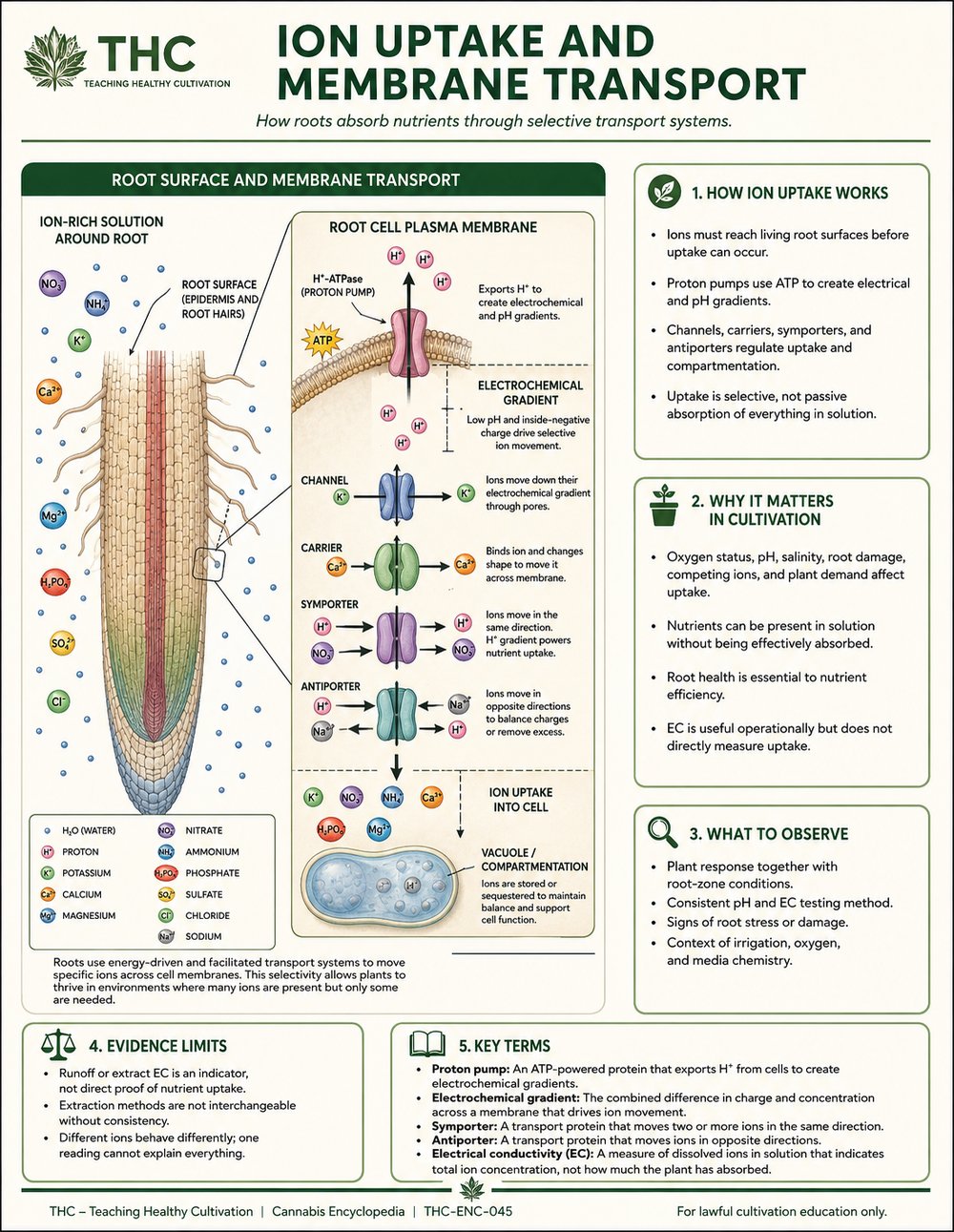
Plants acquire essential elements as ions or small molecules in the root-zone solution. Before an ion becomes plant biomass, it must reach a living root surface, cross membranes through selective transport proteins, move through tissues, and be loaded into long-distance transport pathways. Concentration in a fertilizer tank is only the beginning of that sequence.
Plasma-membrane proton pumps use ATP to export hydrogen ions, establishing electrical and pH gradients. Channels, carriers, symporters, and antiporters use those gradients to regulate uptake and compartmentation. Different transporter systems operate across concentration ranges and respond to plant demand, ion identity, temperature, pH, and competing ions.
Uptake is therefore not a passive sponge effect. Oxygen shortage can limit ATP production; salinity lowers external water potential; root damage removes membrane area; pH changes ion form and availability; and antagonistic ions can alter transport. Plants can also exclude, retrieve, store, or export ions.
Electrical conductivity is an aggregate response of dissolved charged species, weighted by concentration, charge and ionic mobility. Equal EC readings from two solutions do not establish equal nitrate, ammonium, potassium, calcium, magnesium or sodium concentrations. Solution analysis and formulation records identify ion composition; EC by itself cannot diagnose a missing element or quantify net plant uptake.
Electrochemical gradients combine the chemical concentration difference and voltage across a membrane. An ion channel can permit movement down its electrochemical gradient, whereas ATP-driven proton pumps build gradients used by coupled carriers. Transporter selectivity, regulation and subcellular storage determine how a root handles particular ions. Changes in oxygen supply can reduce the energy available to maintain these gradients without changing the total fertilizer present.
Why this matters in cultivation
- Correct nutrient problems by combining root health, solution EC and pH, substrate extract, water chemistry, environmental demand, and tissue data when available. A stronger feed can worsen a transport problem.
- Runoff EC is an operational indicator, not a direct measure of what entered roots. Keep the extraction method consistent before comparing values.
- Worked interpretation: a crop has higher-than-usual drainage EC, marginal leaf injury and a wet root zone. Do not assume potassium deficiency or simply increase feed. Compare water-source chemistry, fertilizer formulation, sampling technique, substrate water status, root health and progression of symptoms before selecting a corrective change.
- After a change in fertilizer formulation, assess trends across comparable irrigation events rather than treating a single drain sample as proof of uptake. Record whether the water volume, source, substrate extraction method and environmental demand remained comparable.
Measure and record
Inputs
Fertilizer formulation, batch, mixing order, volume, pH, EC, and temperature.
Root zone
Extraction method, pH, EC, moisture state, and sampling location.
Water chemistry
Alkalinity, hardness, sodium, chloride, and laboratory report when relevant.
Plant pattern
Affected tissue age, distribution, progression, and photographs.
Confirmation
Tissue test, media test, corrective action, and follow-up response.
Differential nutrient-transport investigation
Log source-water alkalinity and ionic analysis if available, applied formulation and EC/pH, standardized substrate extract or leachate EC/pH, root-zone moisture/temperature/oxygen status, symptom progression and any laboratory tissue results.
Common misconceptions
Misconception: If an ion is in solution the plant absorbed it
Correction: Availability, membrane transport, and plant demand still control uptake.
Misconception: Higher EC means better nutrition
Correction: It means more dissolved charge and can also signal osmotic stress.
Misconception: One nutrient ratio controls every interaction
Correction: Transport and response depend on concentration, form, pH, tissue demand, and environment.
Misconception: Identical EC readings guarantee identical nutrient supply
Correction: different ionic compositions and mobilities can produce the same conductivity.
Evidence limits and uncertainty
Transporter-level mechanisms are well established in model and crop plants, but cannabis-specific uptake kinetics and cultivar comparisons remain incomplete.
The relative roles of ion transporters, rhizosphere pH, cation competition and root developmental stages cannot be resolved from runoff EC or visual leaf symptoms alone. Detailed molecular regulation and uptake kinetics are largely extrapolated from non-cannabis models.
Check your reasoning
- For "Ion Uptake and Membrane Transport", explain the mechanism behind this objective: Explain how mineral ions cross root-cell membranes and why solution concentration alone does not prove nutrient uptake. Which observation or measurement would best test whether that mechanism is operating in the real crop?
- A learner claims, "If an ion is in solution the plant absorbed it" Use the lesson’s science and evidence limits to explain why that claim is unreliable, then name one observation or measurement that could separate the competing explanations.
- Applied case — Correct nutrient problems by combining root health, solution EC and pH, substrate extract, water chemistry, environmental demand, and tissue data when available. A stronger feed can worsen a transport problem. Build a verification plan using the lesson’s record set (Inputs, Root zone, Water chemistry). What would you compare before and after the action, and what result would make you revise the original interpretation?
Require lesson-specific evidence, not memorized universal targets. Open the rationales after you have written or discussed your own answer.
Answer rationale 1: Mechanism / workflow rationale
- A strong answer should connect the response to the lesson objective: Explain how mineral ions cross root-cell membranes and why solution concentration alone does not prove nutrient uptake.
- Plants acquire essential elements as ions or small molecules in the root-zone solution. Before an ion becomes plant biomass, it must reach a living root surface, cross membranes through selective transport proteins, move through tissues, and be loaded into long-distance transport pathways. Concentration in a fertilizer tank is only the beginning of that sequence.
- Plasma-membrane proton pumps use ATP to export hydrogen ions, establishing electrical and pH gradients. Channels, carriers, symporters, and antiporters use those gradients to regulate uptake and compartmentation. Different transporter systems operate across concentration ranges and respond to plant demand, ion identity, temperature, pH, and competing ions.
- The most useful verification evidence includes Inputs: Fertilizer formulation, batch, mixing order, volume, pH, EC, and temperature.
- Keep this limit explicit: Transporter-level mechanisms are well established in model and crop plants, but cannabis-specific uptake kinetics and cultivar comparisons remain incomplete.
Answer rationale 2: Misconception rationale
- The shortcut is unreliable because the lesson explicitly teaches a more conditional explanation.
- Representative misconception: If an ion is in solution the plant absorbed it: Availability, membrane transport, and plant demand still control uptake.
- Plants acquire essential elements as ions or small molecules in the root-zone solution. Before an ion becomes plant biomass, it must reach a living root surface, cross membranes through selective transport proteins, move through tissues, and be loaded into long-distance transport pathways. Concentration in a fertilizer tank is only the beginning of that sequence.
- A useful discriminator is Root zone: Extraction method, pH, EC, moisture state, and sampling location.
- Do not overextend the conclusion beyond this limit: Transporter-level mechanisms are well established in model and crop plants, but cannabis-specific uptake kinetics and cultivar comparisons remain incomplete.
Answer rationale 3: Applied verification rationale
- In practice: Correct nutrient problems by combining root health, solution EC and pH, substrate extract, water chemistry, environmental demand, and tissue data when available. A stronger feed can worsen a transport problem.
- Record before action: Inputs: Fertilizer formulation, batch, mixing order, volume, pH, EC, and temperature.
- Also record: Root zone: Extraction method, pH, EC, moisture state, and sampling location.
- After the action, repeat the same measurement or observation so the comparison is valid.
- Revise the interpretation if the result conflicts with the lesson limit or the expected response: Transporter-level mechanisms are well established in model and crop plants, but cannabis-specific uptake kinetics and cultivar comparisons remain incomplete.
Related lessons
Sources and evidence
- Blatt MR. A charged existence: A century of transmembrane ion transport in plants. Plant Physiology. 2024;195(1):79–110. doi:10.1093/plphys/kiad630. Open source
- THC – Teaching Healthy Cultivation. Cannabis Plant Science Source Packet, version 1. Project source packet supplied by the publisher.
- Camberato DM, Lopez RG, Mickelbart MV. Commercial Greenhouse Production: pH and Electrical Conductivity Measurements in Soilless Substrates. Purdue Extension HO-237-W. 2009. Open source
Downloads
No lesson-specific download is approved for this release. Use browser print/save-to-PDF when you need an offline reading copy.