Root-Zone Pathogens and Predisposing Conditions
Separate disease agents from predisposing root-zone conditions and use a structured diagnostic process for root decline.
Separate disease agents from predisposing root-zone conditions and use a structured diagnostic process for root decline.
Core science
Cannabis root and crown diseases involve multiple organisms, including species assigned to Pythium-related oomycetes and Fusarium fungi. Symptoms can include browning, water-soaked lesions, cortical sloughing, stunting, wilt, and plant collapse. Similar symptoms also occur from hypoxia, extreme EC, temperature injury, drought, or chemical damage.
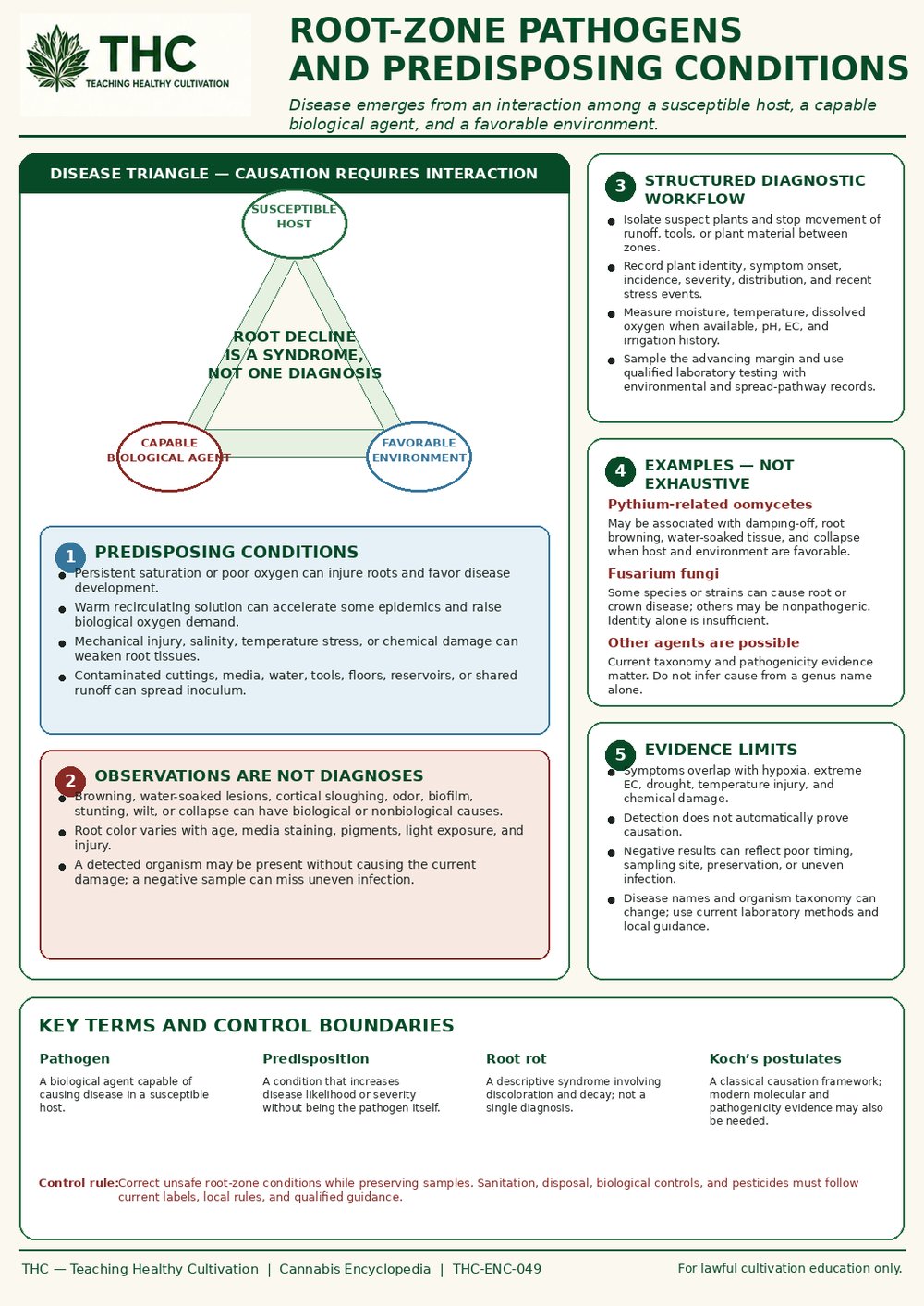
Disease requires a susceptible host, a capable pathogen, and a favorable environment. Saturation and poor oxygen can injure roots and favor propagule movement; warm recirculating solution can accelerate some epidemics; contaminated cuttings, media, water, tools, floors, and reservoirs can introduce or spread inoculum.
A laboratory result must be interpreted carefully. Detecting an organism does not always prove it caused the current symptoms, while a negative sample can miss uneven infection. Sampling should include the advancing margin between healthy and diseased tissue, plus system and environmental records.
Figure THC-ENC-049. Root-Zone Pathogens and Predisposing Conditions. Controlled educational visual for Volume 03; interpret observations and measurements within the lesson’s stated methods and evidence limits.
Why this matters in cultivation
- Isolate suspect plants and stop moving runoff, tools, or plant material between zones. Correct unsafe root-zone conditions while preserving samples for diagnosis.
- Discard decisions, sanitation, biological controls, or pesticides must follow local rules and product labels. This encyclopedia does not substitute for a licensed diagnostic lab or pesticide label.
Measure and record
Case identity
Plant, cultivar/clone, room, bench, lot, and symptom onset.
Symptoms
Incidence, severity, distribution, root/crown appearance, odor, and photographs.
Environment
Moisture, temperature, oxygen if measured, pH, EC, and irrigation history.
Spread pathways
Water source, recirculation, tools, media, incoming plants, and pest activity.
Testing and action
Sample method, lab result, isolation, disposal, treatment label, and follow-up.
Common misconceptions
Misconception: Brown roots prove Pythium
Correction: Discoloration has multiple biological and nonbiological causes.
Misconception: Overwatering is itself a pathogen
Correction: It is a management condition that can injure roots and favor disease.
Misconception: One healthy-looking root proves the system is clean
Correction: Infection and environmental injury can be uneven.
Evidence limits and uncertainty
Species identification and pathogenicity testing are not always available. Disease names and organism taxonomy can change; use current laboratory methods and local guidance.
Check your reasoning
- For "Root-Zone Pathogens and Predisposing Conditions", explain the mechanism behind this objective: Separate disease agents from predisposing root-zone conditions and use a structured diagnostic process for root decline. Which observation or measurement would best test whether that mechanism is operating in the real crop?
- A learner claims, "Brown roots prove Pythium" Use the lesson’s science and evidence limits to explain why that claim is unreliable, then name one observation or measurement that could separate the competing explanations.
- Applied case — Isolate suspect plants and stop moving runoff, tools, or plant material between zones. Correct unsafe root-zone conditions while preserving samples for diagnosis. Build a verification plan using the lesson’s record set (Case identity, Symptoms, Environment). What would you compare before and after the action, and what result would make you revise the original interpretation?
Require lesson-specific evidence, not memorized universal targets. Open the rationales after you have written or discussed your own answer.
Answer rationale 1: Mechanism / workflow rationale
- A strong answer should connect the response to the lesson objective: Separate disease agents from predisposing root-zone conditions and use a structured diagnostic process for root decline.
- Cannabis root and crown diseases involve multiple organisms, including species assigned to Pythium-related oomycetes and Fusarium fungi. Symptoms can include browning, water-soaked lesions, cortical sloughing, stunting, wilt, and plant collapse. Similar symptoms also occur from hypoxia, extreme EC, temperature injury, drought, or chemical damage.
- Disease requires a susceptible host, a capable pathogen, and a favorable environment. Saturation and poor oxygen can injure roots and favor propagule movement; warm recirculating solution can accelerate some epidemics; contaminated cuttings, media, water, tools, floors, and reservoirs can introduce or spread inoculum.
- The most useful verification evidence includes Case identity: Plant, cultivar/clone, room, bench, lot, and symptom onset.
- Keep this limit explicit: Species identification and pathogenicity testing are not always available. Disease names and organism taxonomy can change; use current laboratory methods and local guidance.
Answer rationale 2: Misconception rationale
- The shortcut is unreliable because the lesson explicitly teaches a more conditional explanation.
- Representative misconception: Brown roots prove Pythium: Discoloration has multiple biological and nonbiological causes.
- Cannabis root and crown diseases involve multiple organisms, including species assigned to Pythium-related oomycetes and Fusarium fungi. Symptoms can include browning, water-soaked lesions, cortical sloughing, stunting, wilt, and plant collapse. Similar symptoms also occur from hypoxia, extreme EC, temperature injury, drought, or chemical damage.
- A useful discriminator is Symptoms: Incidence, severity, distribution, root/crown appearance, odor, and photographs.
- Do not overextend the conclusion beyond this limit: Species identification and pathogenicity testing are not always available. Disease names and organism taxonomy can change; use current laboratory methods and local guidance.
Answer rationale 3: Applied verification rationale
- In practice: Isolate suspect plants and stop moving runoff, tools, or plant material between zones. Correct unsafe root-zone conditions while preserving samples for diagnosis.
- Record before action: Case identity: Plant, cultivar/clone, room, bench, lot, and symptom onset.
- Also record: Symptoms: Incidence, severity, distribution, root/crown appearance, odor, and photographs.
- After the action, repeat the same measurement or observation so the comparison is valid.
- Revise the interpretation if the result conflicts with the lesson limit or the expected response: Species identification and pathogenicity testing are not always available. Disease names and organism taxonomy can change; use current laboratory methods and local guidance.
Worked example: Root decline after repeated wet irrigation
Scenario: Plants in one irrigation zone lose vigor and develop brown roots after a period of frequent irrigation. The first assumption is that a root pathogen is definitely responsible.
Reasoning path
- Treat brown roots and poor vigor as evidence of root decline, not proof of a particular pathogen.
- Compare affected and unaffected plants from the same cohort and map whether the problem follows an irrigation zone, media lot, cultivar, or propagation source.
- Measure root-zone moisture, drainage, temperature, EC, irrigation timing, and oxygen-related context before interpreting pathogen tests.
- Inspect roots for lesion pattern and sample early symptomatic tissue when laboratory confirmation is warranted.
- Keep abiotic predisposition, pathogen involvement, and mixed causes in the differential until the spatial pattern, root-zone data, and diagnostic evidence agree.
Evidence to collect
- root appearance and lesion distribution
- irrigation frequency/volume and delivery uniformity
- media moisture and drainage
- root-zone temperature and EC
- affected-versus-unaffected spatial map
- propagation/media lot history
- laboratory or microscopy results when used
Common weak answers
- Brown roots prove Pythium or another single pathogen.
- Wet media alone proves disease.
- Finding one organism means root-zone stress no longer matters.
Verification: A stronger conclusion requires the proposed cause to match the crop pattern and root findings, and the corrective plan should improve new root and shoot growth while repeat measurements show the predisposing condition or confirmed disease pressure has changed.
Applicability boundary: Root disease severity depends on organism, host, media, water status, temperature, sanitation, and sampling. This example does not establish a universal irrigation frequency or pathogen diagnosis.
Related lessons
Sources and evidence
- Punja ZK. Emerging diseases of Cannabis sativa and sustainable management. Pest Management Science. 2021;77(9):3857–3870. doi:10.1002/ps.6307. Open source
- THC – Teaching Healthy Cultivation. Cannabis Plant Science Source Packet, version 1. Project source packet supplied by the publisher.
- Loreti E, Perata P. The Many Facets of Hypoxia in Plants. Plants. 2020;9(6):745. doi:10.3390/plants9060745. Open source
- Francl LJ. The Disease Triangle: A Plant Pathological Paradigm Revisited. The Plant Health Instructor. 2001. doi:10.1094/PHI-T-2001-0517-01. Open source
- Bhunjun CS, et al. Importance of Molecular Data to Identify Fungal Plant Pathogens and Guidelines for Pathogenicity Testing Based on Koch’s Postulates. Pathogens. 2021;10(9):1096. doi:10.3390/pathogens10091096. Open source
Downloads
No lesson-specific download is approved for this release. Use browser print/save-to-PDF when you need an offline reading copy.