Root Respiration and Oxygen Demand
Explain why roots require oxygen and recognize how media saturation, temperature, and biological activity change oxygen supply and demand.
Explain why roots require oxygen and recognize how media saturation, temperature, and biological activity change oxygen supply and demand.
Core science
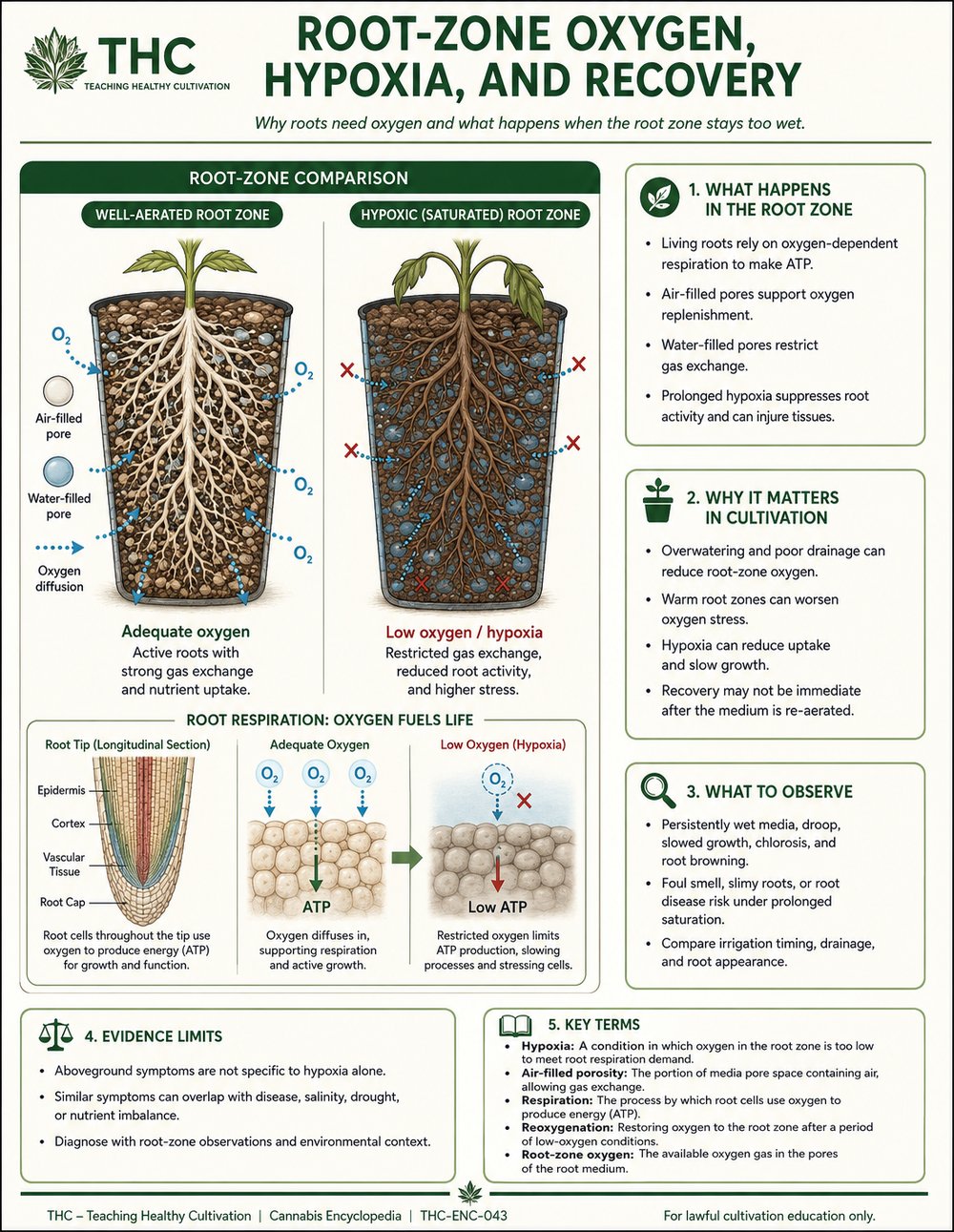
Living roots respire continuously. ATP generated by respiration supports membrane transport, biosynthesis, growth, repair, and defense. Roots receive sugars from photosynthetic tissues through the phloem, but carbon supply is useful only if the cells can metabolize it under their prevailing oxygen conditions.
Water-filled pores restrict gas diffusion. After irrigation, oxygen must be replenished through connected air-filled pores or through a moving, oxygenated nutrient solution. Root and microbial respiration consume that supply. Warmer water holds less dissolved oxygen at equilibrium. Warm root zones can also increase root and microbial respiration, so oxygen supply and biological demand must be evaluated separately.
Under hypoxia, plants shift metabolism and conserve energy; prolonged or severe oxygen shortage suppresses growth and ion uptake and can cause tissue death. Returning oxygen does not instantly restore function. Damaged tissues may undergo oxidative injury and become more susceptible to opportunistic pathogens.
Mechanistic sequence during oxygen depletion: water occupies formerly gas-filled pores, so replenishment of O2 from the atmosphere slows while roots and microorganisms continue consuming it. Oxygen availability then becomes spatially heterogeneous; the interior of a wet or compacted root zone may be depleted while its surface remains aerated. A reading from the drainage stream or one sensor location cannot establish the oxygen status of every root.
When mitochondrial oxidative phosphorylation is oxygen-limited, cells may increase glycolysis and fermentation to regenerate NAD+ so glycolysis can continue. This supports limited short-term ATP production but cannot sustain the same energetic demands as normal aerobic respiration. The consequences for proton pumps, mineral uptake, growth, and membrane maintenance help explain why a saturated root zone can cause nutrient-like symptoms even when the dissolved nutrients are present.
Plant species differ in flooding adaptations such as aerenchyma formation, adventitious roots, and barriers to radial oxygen loss. Evidence for these responses in rice or other flood-tolerant crops cannot be assumed to describe commercial cannabis cultivars. Duration, root age, genotype, and the difference between partial hypoxia and anoxia change likely outcomes.
Why this matters in cultivation
- The practical target is not ‘dry media’; it is a repeatable air-water balance. Irrigation should fully wet the intended root volume, then allow adequate drainage and gas exchange before the next event.
- In water culture, bubbling, circulation, temperature, root density, biofilms, and pump reliability all affect oxygen delivery. Air stones do not eliminate the need to inspect roots and verify system function.
- Example interpretation: a container that remains unusually heavy for several days, drains slowly, and shows persistent wilt should trigger investigation of distribution, compaction, drainage, root health, and atmospheric demand before adding fertilizer. Compare with similarly aged plants under the same environment; one symptom is not a diagnosis.
- In recirculating water systems, dissolved-oxygen readings are location- and time-specific. Note where and when the sensor was calibrated and placed. A satisfactory reservoir reading does not rule out low-oxygen boundary layers within dense root mats, stagnant channels, or biofilms.
Measure and record
Irrigation
Start and stop times, volume, drainage, interval, and observed saturation.
Root-zone conditions
Temperature, moisture or water content, and dissolved oxygen when instrumented.
Media
Particle size, porosity data, compaction, decomposition, and container geometry.
Plant response
Wilt, slowed growth, leaf color, root color/odor, and recovery after irrigation changes.
System reliability
Pump status, aeration status, alarm events, and maintenance.
Differential observation protocol
Record substrate mass or moisture trend, last irrigation time, drainage duration, temperature, visible roots, plant response, and any comparison plant. State which measurements were direct and which were inferred.
Common misconceptions
Misconception: Roots only need water and nutrients
Correction: Root metabolism also requires oxygen.
Misconception: A wet medium contains plenty of oxygen because water contains oxygen
Correction: Dissolved oxygen is limited and replenishes slowly without exchange.
Misconception: More bubbles always solve hypoxia
Correction: Temperature, root load, biofilms, circulation, and gas transfer also matter.
Misconception: A single dissolved-oxygen value proves all roots are aerated
Correction: spatial mixing, root density, and changing oxygen demand make reservoir or outlet measurements incomplete.
Evidence limits and uncertainty
Visible symptoms are not specific to hypoxia. Salinity, drought, root pathogens, temperature injury, and nutrient imbalance can produce similar aboveground responses.
General crop and wetland hypoxia mechanisms are informative but are not cultivar-specific cannabis tolerance thresholds. No universal water-content, dissolved-oxygen concentration, or irrigation interval diagnoses root hypoxia across soil, coco, rockwool, and water culture.
Check your reasoning
- For "Root Respiration and Oxygen Demand", explain the mechanism behind this objective: Explain why roots require oxygen and recognize how media saturation, temperature, and biological activity change oxygen supply and demand. Which observation or measurement would best test whether that mechanism is operating in the real crop?
- A learner claims, "Roots only need water and nutrients" Use the lesson’s science and evidence limits to explain why that claim is unreliable, then name one observation or measurement that could separate the competing explanations.
- Applied case — The practical target is not ‘dry media’; it is a repeatable air-water balance. Irrigation should fully wet the intended root volume, then allow adequate drainage and gas exchange before the next event. Build a verification plan using the lesson’s record set (Irrigation, Root-zone conditions, Media). What would you compare before and after the action, and what result would make you revise the original interpretation?
Require lesson-specific evidence, not memorized universal targets. Open the rationales after you have written or discussed your own answer.
Answer rationale 1: Mechanism / workflow rationale
- A strong answer should connect the response to the lesson objective: Explain why roots require oxygen and recognize how media saturation, temperature, and biological activity change oxygen supply and demand.
- Living roots respire continuously. ATP generated by respiration supports membrane transport, biosynthesis, growth, repair, and defense. Roots receive sugars from photosynthetic tissues through the phloem, but carbon supply is useful only if the cells can metabolize it under their prevailing oxygen conditions.
- Water-filled pores restrict gas diffusion. After irrigation, oxygen must be replenished through connected air-filled pores or through a moving, oxygenated nutrient solution. Root and microbial respiration consume that supply. Warmer water holds less dissolved oxygen at equilibrium. Warm root zones can also increase root and microbial respiration, so oxygen supply and biological demand must be evaluated separately.
- The most useful verification evidence includes Irrigation: Start and stop times, volume, drainage, interval, and observed saturation.
- Keep this limit explicit: Visible symptoms are not specific to hypoxia. Salinity, drought, root pathogens, temperature injury, and nutrient imbalance can produce similar aboveground responses.
Answer rationale 2: Misconception rationale
- The shortcut is unreliable because the lesson explicitly teaches a more conditional explanation.
- Representative misconception: Roots only need water and nutrients: Root metabolism also requires oxygen.
- Living roots respire continuously. ATP generated by respiration supports membrane transport, biosynthesis, growth, repair, and defense. Roots receive sugars from photosynthetic tissues through the phloem, but carbon supply is useful only if the cells can metabolize it under their prevailing oxygen conditions.
- A useful discriminator is Root-zone conditions: Temperature, moisture or water content, and dissolved oxygen when instrumented.
- Do not overextend the conclusion beyond this limit: Visible symptoms are not specific to hypoxia. Salinity, drought, root pathogens, temperature injury, and nutrient imbalance can produce similar aboveground responses.
Answer rationale 3: Applied verification rationale
- In practice: The practical target is not ‘dry media’; it is a repeatable air-water balance. Irrigation should fully wet the intended root volume, then allow adequate drainage and gas exchange before the next event.
- Record before action: Irrigation: Start and stop times, volume, drainage, interval, and observed saturation.
- Also record: Root-zone conditions: Temperature, moisture or water content, and dissolved oxygen when instrumented.
- After the action, repeat the same measurement or observation so the comparison is valid.
- Revise the interpretation if the result conflicts with the lesson limit or the expected response: Visible symptoms are not specific to hypoxia. Salinity, drought, root pathogens, temperature injury, and nutrient imbalance can produce similar aboveground responses.
Related lessons
Sources and evidence
- THC – Teaching Healthy Cultivation. Cannabis Plant Science Source Packet, version 1. Project source packet supplied by the publisher.
- Loreti E, Perata P. The Many Facets of Hypoxia in Plants. Plants. 2020;9(6):745. doi:10.3390/plants9060745.
- Benson BB, Krause D Jr. The concentration and isotopic fractionation of gases dissolved in freshwater in equilibrium with the atmosphere. 1. Oxygen. Limnology and Oceanography. 1980;25(4):662-671. doi:10.4319/lo.1980.25.4.0662. See also USGS DOTABLES dissolved-oxygen solubility implementation.
- Nemali K. Greenhouse and Indoor Production of Horticultural Crops: Understanding the Pores of a Soilless Substrate. Purdue Extension HO-287-W. 2018.
- Dunn B. Hydroponics. Oklahoma State University Extension HLA-6442. Revised 2025.
- Drew MC. Oxygen deficiency and root metabolism: injury and acclimation under hypoxia and anoxia. Annual Review of Plant Physiology and Plant Molecular Biology. 1997;48:223–250. doi:10.1146/annurev.arplant.48.1.223. Mechanistic review; cross-species transfer requires qualification.
- Sauter M. Root responses to flooding. Current Opinion in Plant Biology. 2013;16(3):282–286. doi:10.1016/j.pbi.2013.03.013. Flooding adaptations reviewed across plant species, not cannabis-specific validation.
Downloads
No lesson-specific download is approved for this release. Use browser print/save-to-PDF when you need an offline reading copy.