Root Tips, Meristems, and Zones of Development
Identify the developmental regions near a cannabis root tip and explain why the youngest tissues are both productive and easily damaged.
Identify the developmental regions near a cannabis root tip and explain why the youngest tissues are both productive and easily damaged.
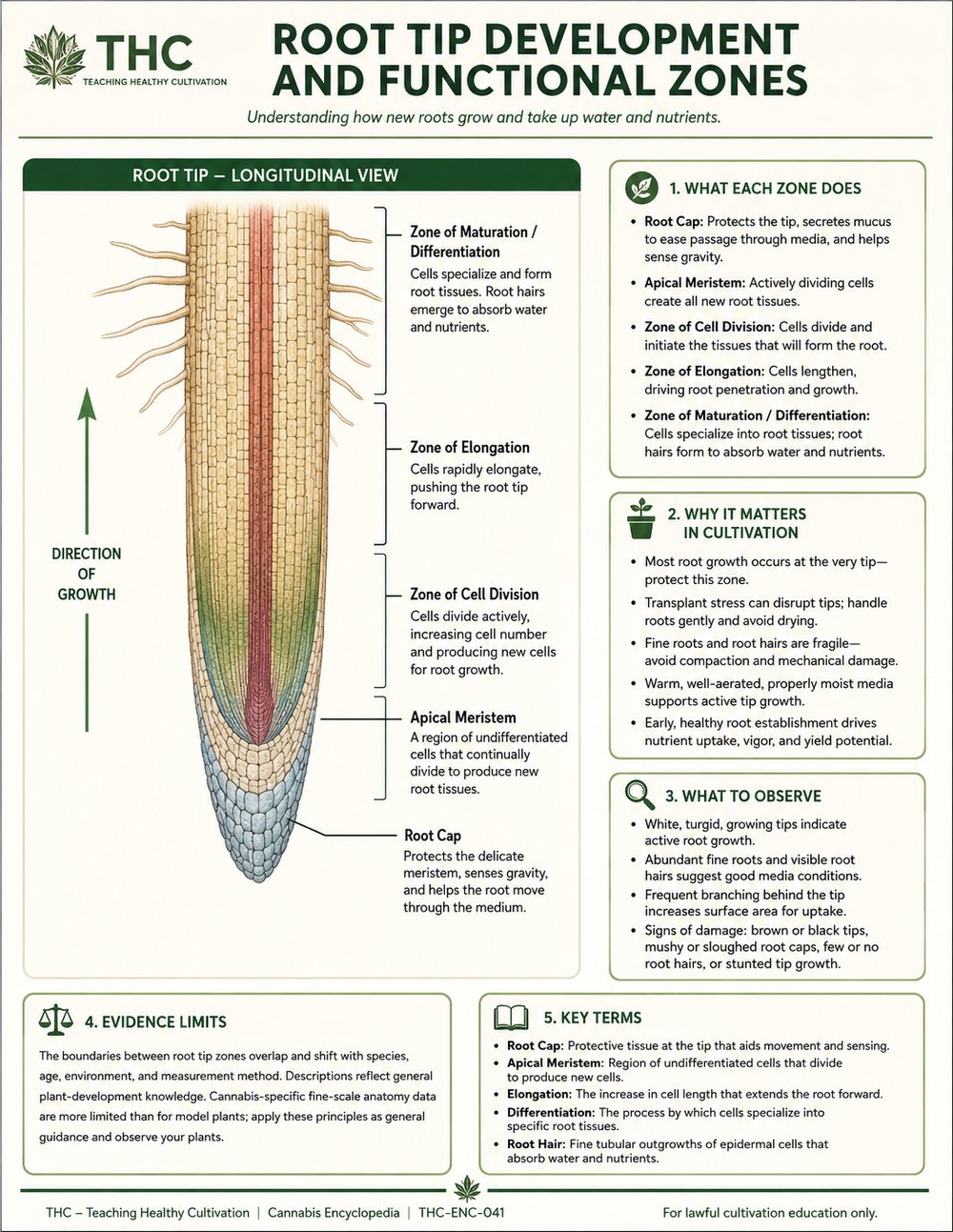
Core science
A growing root tip is an organized developmental gradient, not a uniform white thread. The root cap protects the apex as it moves through pores. Immediately behind it, the apical meristem produces cells. Those cells then elongate and differentiate into epidermis, cortex, endodermis, pericycle, xylem, and phloem. These are developmental regions rather than fixed universal bands; their apparent boundaries depend on cellular activity, species, age, environment, and measurement method.
Water and mineral acquisition are not restricted to the visible tip, but young unsuberized regions and root hairs are especially active interfaces. Older root regions increasingly emphasize axial transport, anchorage, lateral-root formation, and storage. Root color alone cannot identify function: healthy young roots may be white or cream, while pigments, media staining, age, and light exposure can alter appearance.
Cannabis-specific root imaging remains less developed than shoot research. Root-TRAPR and newer industrial-hemp architecture studies show why roots must be measured in controlled systems: genotype, developmental stage, medium, water distribution, and container boundaries alter the observed architecture.
Why this matters in cultivation
- Mechanical damage or drying during transplanting can impair fine-root function and delay restoration of plant water relations. Handle plugs by the media mass, avoid pulling on the stem, minimize root exposure, and prevent young roots from drying in air.
- Root-tip loss is not automatically fatal because lateral roots can replace part of the system, but recovery costs time and depends on stored carbon, shoot demand, oxygen, temperature, and disease pressure.
Measure and record
Plant identity
Cultivar or clone, plant ID, age, and propagation method.
Root observation
Root color, visible tip density, lesions, branching, and media adherence.
Handling event
Transplant date, plug moisture, root disturbance, and time roots were exposed.
Environment
Root-zone temperature, moisture status, irrigation history, and EC.
Recovery
Wilt duration, new growth, irrigation response, and survival.
Common misconceptions
Misconception: All white roots are equally active
Correction: Root function varies by age, tissue differentiation, and environment.
Misconception: A damaged tip can never regrow
Correction: New lateral roots may compensate, although recovery is not cost-free.
Misconception: More root exposure improves inspection
Correction: Drying and mechanical disturbance can create the damage being inspected.
Evidence limits and uncertainty
Exact zone lengths and activity patterns vary with genotype, age, temperature, water status, nutrient status, oxygen, and measurement method. Cannabis-specific anatomical quantification is still limited.
Check your reasoning
- For "Root Tips, Meristems, and Zones of Development", explain the mechanism behind this objective: Identify the developmental regions near a cannabis root tip and explain why the youngest tissues are both productive and easily damaged. Which observation or measurement would best test whether that mechanism is operating in the real crop?
- A learner claims, "All white roots are equally active" Use the lesson’s science and evidence limits to explain why that claim is unreliable, then name one observation or measurement that could separate the competing explanations.
- Applied case — Mechanical damage or drying during transplanting can impair fine-root function and delay restoration of plant water relations. Handle plugs by the media mass, avoid pulling on the stem, minimize root exposure, and prevent young roots from drying in air. Build a verification plan using the lesson’s record set (Plant identity, Root observation, Handling event). What would you compare before and after the action, and what result would make you revise the original interpretation?
Require lesson-specific evidence, not memorized universal targets. Open the rationales after you have written or discussed your own answer.
Answer rationale 1: Mechanism / workflow rationale
- A strong answer should connect the response to the lesson objective: Identify the developmental regions near a cannabis root tip and explain why the youngest tissues are both productive and easily damaged.
- A growing root tip is an organized developmental gradient, not a uniform white thread. The root cap protects the apex as it moves through pores. Immediately behind it, the apical meristem produces cells. Those cells then elongate and differentiate into epidermis, cortex, endodermis, pericycle, xylem, and phloem. These are developmental regions rather than fixed universal bands; their apparent boundaries depend on cellular activity, species, age, environment, and measurement method.
- Water and mineral acquisition are not restricted to the visible tip, but young unsuberized regions and root hairs are especially active interfaces. Older root regions increasingly emphasize axial transport, anchorage, lateral-root formation, and storage. Root color alone cannot identify function: healthy young roots may be white or cream, while pigments, media staining, age, and light exposure can alter appearance.
- The most useful verification evidence includes Plant identity: Cultivar or clone, plant ID, age, and propagation method.
- Keep this limit explicit: Exact zone lengths and activity patterns vary with genotype, age, temperature, water status, nutrient status, oxygen, and measurement method. Cannabis-specific anatomical quantification is still limited.
Answer rationale 2: Misconception rationale
- The shortcut is unreliable because the lesson explicitly teaches a more conditional explanation.
- Representative misconception: All white roots are equally active: Root function varies by age, tissue differentiation, and environment.
- A growing root tip is an organized developmental gradient, not a uniform white thread. The root cap protects the apex as it moves through pores. Immediately behind it, the apical meristem produces cells. Those cells then elongate and differentiate into epidermis, cortex, endodermis, pericycle, xylem, and phloem. These are developmental regions rather than fixed universal bands; their apparent boundaries depend on cellular activity, species, age, environment, and measurement method.
- A useful discriminator is Root observation: Root color, visible tip density, lesions, branching, and media adherence.
- Do not overextend the conclusion beyond this limit: Exact zone lengths and activity patterns vary with genotype, age, temperature, water status, nutrient status, oxygen, and measurement method. Cannabis-specific anatomical quantification is still limited.
Answer rationale 3: Applied verification rationale
- In practice: Mechanical damage or drying during transplanting can impair fine-root function and delay restoration of plant water relations. Handle plugs by the media mass, avoid pulling on the stem, minimize root exposure, and prevent young roots from drying in air.
- Record before action: Plant identity: Cultivar or clone, plant ID, age, and propagation method.
- Also record: Root observation: Root color, visible tip density, lesions, branching, and media adherence.
- After the action, repeat the same measurement or observation so the comparison is valid.
- Revise the interpretation if the result conflicts with the lesson limit or the expected response: Exact zone lengths and activity patterns vary with genotype, age, temperature, water status, nutrient status, oxygen, and measurement method. Cannabis-specific anatomical quantification is still limited.
Related lessons
Sources and evidence
- THC – Teaching Healthy Cultivation. Cannabis Plant Science Source Packet, version 1. Project source packet supplied by the publisher.
- Suwanchaikasem P, Idnurm A, Selby-Pham J, et al. Root-TRAPR: a modular plant growth device to visualize root development and monitor growth parameters, as applied to an elicitor response of Cannabis sativa. Plant Methods. 2022;18:46. doi:10.1186/s13007-022-00875-1. Open source
- Morales EY, et al. Diversity of root system architecture and root-shoot biomass allocation in industrial hemp (Cannabis sativa L.). PLOS ONE. 2026;21(2):e0339929. doi:10.1371/journal.pone.0339929. See the May 7, 2026 correction adding omitted author Tyler G. Dowd: doi:10.1371/journal.pone.0349068. Open source
- Muthert LWF, Izzo LG, van Zanten M, Aronne G. Root Tropisms: Investigations on Earth and in Space to Unravel Plant Growth Direction. Frontiers in Plant Science. 2020;10:1807. doi:10.3389/fpls.2019.01807. Open source
- Wilson SJ, Clark RJ. Water relations in Eucalyptus regnans nursery plants following root exposure after lifting. Forest Ecology and Management. 1998;105(1-3):91-98. doi:10.1016/S0378-1127(97)00258-2. Abstract available
Downloads
No lesson-specific download is approved for this release. Use browser print/save-to-PDF when you need an offline reading copy.