Deep Water, Film, Drip, and Aeroponic Root Environments
Compare hydroponic root environments by water delivery, oxygenation, buffering, failure modes, and monitoring needs.
Compare hydroponic root environments by water delivery, oxygenation, buffering, failure modes, and monitoring needs.
Core science
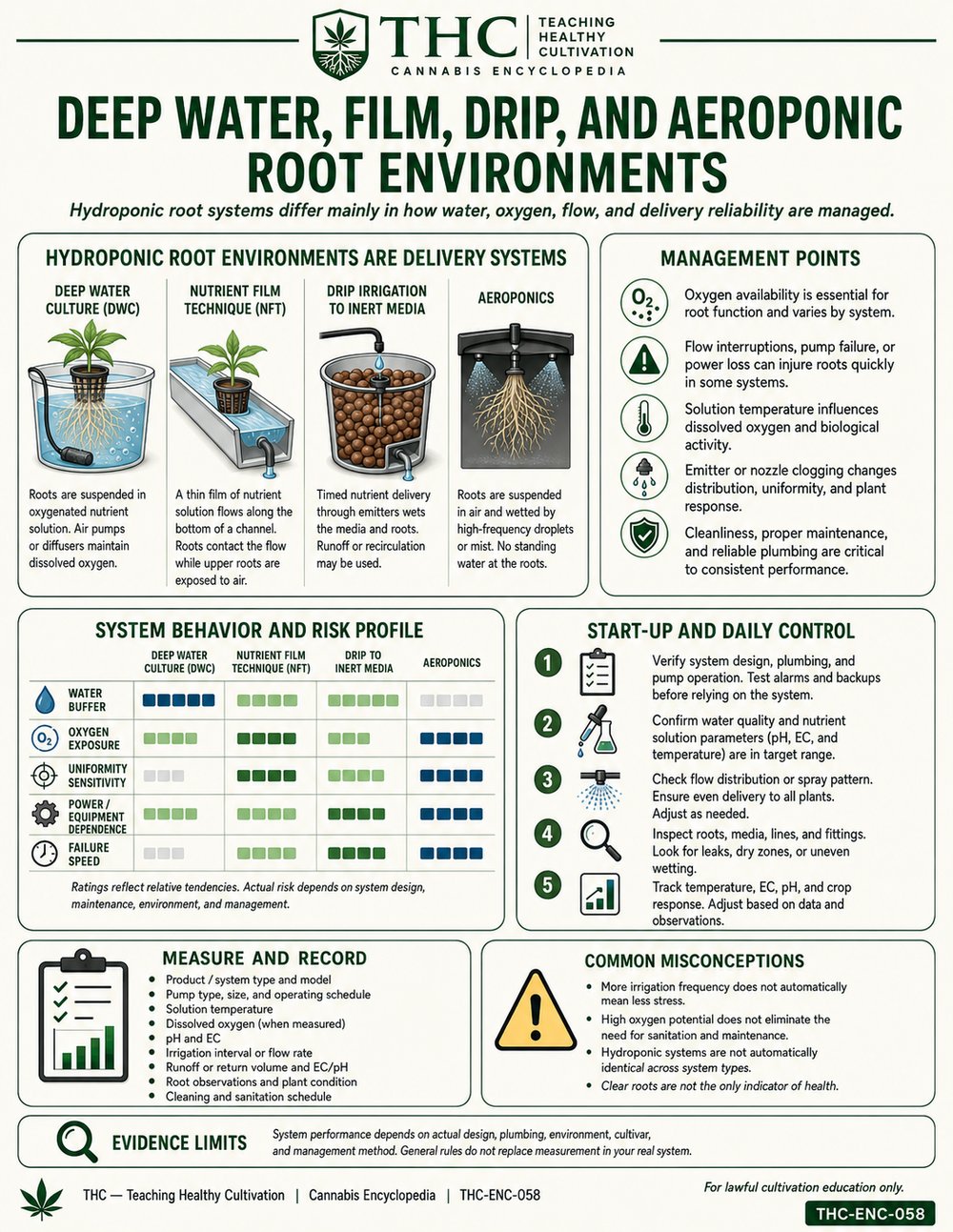
Hydroponics describes nutrient delivery without reliance on field soil; it is not one root environment. Deep-water systems offer a large solution reservoir but depend on aeration, mixing, temperature, sanitation, and chemistry. Film systems provide a shallow flowing solution and exposed root surface but can fail rapidly when flow stops.
Drip systems use rockwool, coir, perlite, or another medium as hydraulic buffer. Open systems discharge drainage; closed systems recapture and recirculate it. Aeroponics provides high root-zone gas exposure but relies on clean nozzles, pressure, droplet distribution, and short interruption tolerance.
Recirculation links plants biologically and chemically. Pathogens, root exudates, additives, pH changes, and nutrient imbalances can spread through the shared solution. Reservoir EC cannot reveal individual ion depletion, so complete solution analysis or planned replacement may be needed.
Figure THC-ENC-058. Deep Water, Film, Drip, and Aeroponic Root Environments. Controlled educational visual for Volume 03; interpret observations and measurements within the lesson’s stated methods and evidence limits.
Why this matters in cultivation
- Select a system by failure tolerance and monitoring capacity, not novelty. Pumps, air supply, temperature control, filtration, alarms, backup power, cleaning access, and spare parts are crop inputs.
- Cannabis nutrient experiments in deep-water culture provide useful treatment data, but their cultivar, solution, stage, and controlled research conditions must accompany any numerical claim.
Measure and record
System
Type, open/closed status, reservoir volume, channels, media, and plant count.
Delivery
Pump/air specifications, flow, pressure, cycle, emitter/nozzle output, and uniformity.
Solution
Temperature, dissolved oxygen, pH, EC, volume, water additions, and lab analysis.
Reliability
Alarm checks, outage duration, backup action, cleaning, and maintenance.
Plant health
Root color/odor, biofilm, disease incidence, uptake, growth, and yield.
Common misconceptions
Misconception: Hydroponics means roots are always in water
Correction: Systems include films, drip media, misted roots, and water culture.
Misconception: Recirculation automatically saves nutrients without risk
Correction: It also accumulates imbalances and connects disease pathways.
Misconception: One reservoir EC proves a complete nutrient profile
Correction: EC measures total conductivity, not individual ion concentrations.
Evidence limits and uncertainty
System names do not define exact engineering. Oxygen transfer, flow, droplet size, solution replacement, and sanitation vary widely across installations.
Check your reasoning
- For "Deep Water, Film, Drip, and Aeroponic Root Environments", explain the mechanism behind this objective: Compare hydroponic root environments by water delivery, oxygenation, buffering, failure modes, and monitoring needs. Which observation or measurement would best test whether that mechanism is operating in the real crop?
- A learner claims, "Hydroponics means roots are always in water" Use the lesson’s science and evidence limits to explain why that claim is unreliable, then name one observation or measurement that could separate the competing explanations.
- Applied case — Select a system by failure tolerance and monitoring capacity, not novelty. Pumps, air supply, temperature control, filtration, alarms, backup power, cleaning access, and spare parts are crop inputs. Build a verification plan using the lesson’s record set (System, Delivery, Solution). What would you compare before and after the action, and what result would make you revise the original interpretation?
Require lesson-specific evidence, not memorized universal targets. Open the rationales after you have written or discussed your own answer.
Answer rationale 1: Mechanism / workflow rationale
- A strong answer should connect the response to the lesson objective: Compare hydroponic root environments by water delivery, oxygenation, buffering, failure modes, and monitoring needs.
- Hydroponics describes nutrient delivery without reliance on field soil; it is not one root environment. Deep-water systems offer a large solution reservoir but depend on aeration, mixing, temperature, sanitation, and chemistry. Film systems provide a shallow flowing solution and exposed root surface but can fail rapidly when flow stops.
- Drip systems use rockwool, coir, perlite, or another medium as hydraulic buffer. Open systems discharge drainage; closed systems recapture and recirculate it. Aeroponics provides high root-zone gas exposure but relies on clean nozzles, pressure, droplet distribution, and short interruption tolerance.
- The most useful verification evidence includes System: Type, open/closed status, reservoir volume, channels, media, and plant count.
- Keep this limit explicit: System names do not define exact engineering. Oxygen transfer, flow, droplet size, solution replacement, and sanitation vary widely across installations.
Answer rationale 2: Misconception rationale
- The shortcut is unreliable because the lesson explicitly teaches a more conditional explanation.
- Representative misconception: Hydroponics means roots are always in water: Systems include films, drip media, misted roots, and water culture.
- Hydroponics describes nutrient delivery without reliance on field soil; it is not one root environment. Deep-water systems offer a large solution reservoir but depend on aeration, mixing, temperature, sanitation, and chemistry. Film systems provide a shallow flowing solution and exposed root surface but can fail rapidly when flow stops.
- A useful discriminator is Delivery: Pump/air specifications, flow, pressure, cycle, emitter/nozzle output, and uniformity.
- Do not overextend the conclusion beyond this limit: System names do not define exact engineering. Oxygen transfer, flow, droplet size, solution replacement, and sanitation vary widely across installations.
Answer rationale 3: Applied verification rationale
- In practice: Select a system by failure tolerance and monitoring capacity, not novelty. Pumps, air supply, temperature control, filtration, alarms, backup power, cleaning access, and spare parts are crop inputs.
- Record before action: System: Type, open/closed status, reservoir volume, channels, media, and plant count.
- Also record: Delivery: Pump/air specifications, flow, pressure, cycle, emitter/nozzle output, and uniformity.
- After the action, repeat the same measurement or observation so the comparison is valid.
- Revise the interpretation if the result conflicts with the lesson limit or the expected response: System names do not define exact engineering. Oxygen transfer, flow, droplet size, solution replacement, and sanitation vary widely across installations.
Related lessons
Sources and evidence
- Dunn B. Hydroponics. Oklahoma State University Extension HLA-6442. Revised 2025. Open source
- Bevan L, Jones M, Zheng Y. Optimisation of Nitrogen, Phosphorus, and Potassium for Soilless Production of Cannabis sativa in the Flowering Stage Using Response Surface Analysis. Frontiers in Plant Science. 2021;12:764103. doi:10.3389/fpls.2021.764103. Open source
- Punja ZK. Emerging diseases of Cannabis sativa and sustainable management. Pest Management Science. 2021;77(9):3857–3870. doi:10.1002/ps.6307. Open source
Downloads
No lesson-specific download is approved for this release. Use browser print/save-to-PDF when you need an offline reading copy.