Water Uptake Pathways Through Roots
Trace water from the external root zone to the xylem and explain why uptake depends on gradients, anatomy, contact, and hydraulic regulation.
Trace water from the external root zone to the xylem and explain why uptake depends on gradients, anatomy, contact, and hydraulic regulation.
Core science
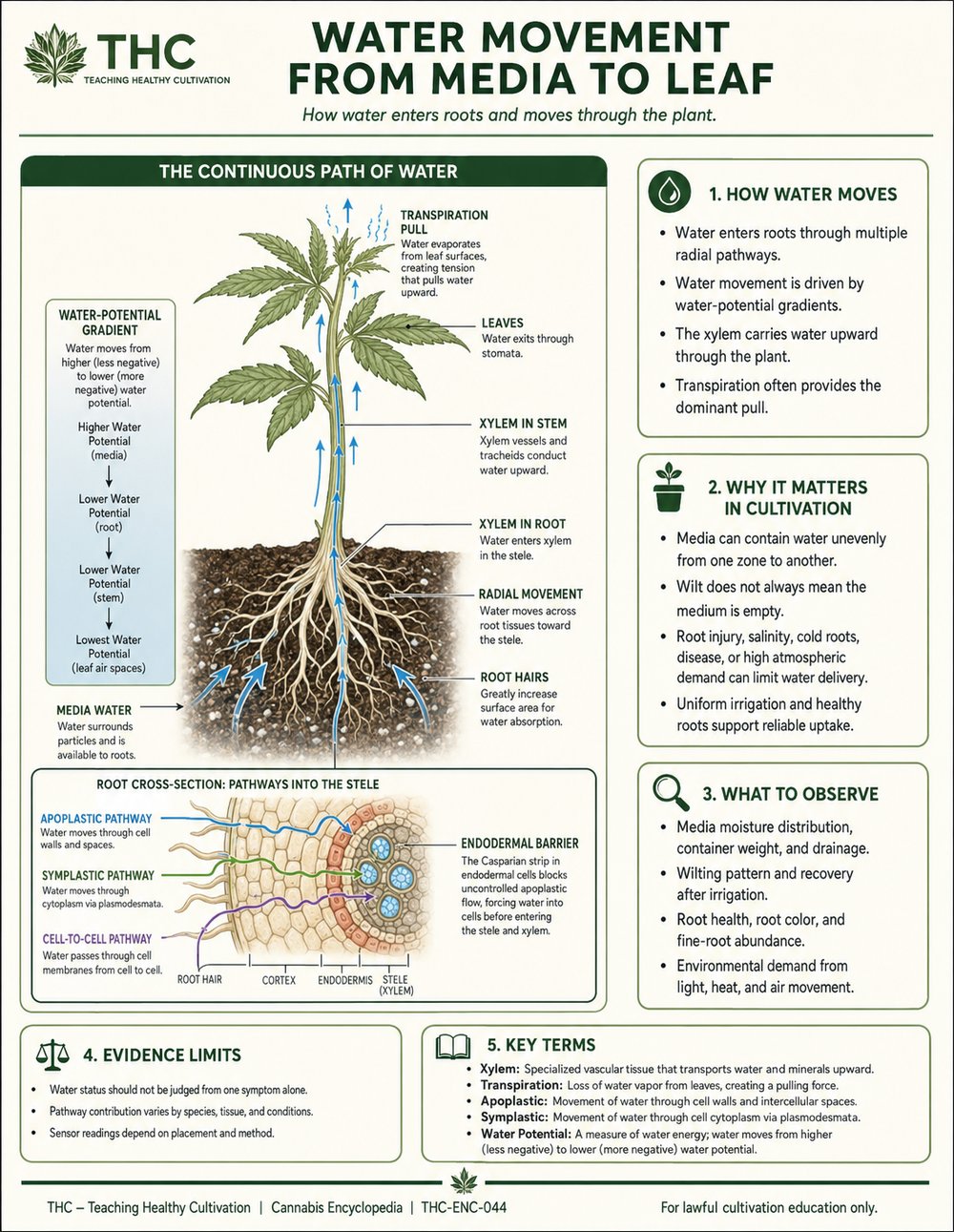
Water moves through soil or substrate pores toward root surfaces, crosses the root radially, and then travels upward in xylem. Radial movement can use apoplastic, cell-to-cell, and symplastic routes. Endodermal barriers restrict uncontrolled apoplastic flow and require water and dissolved substances to cross membranes before entering the stele.
The driving force is a water-potential gradient across the soil-plant-atmosphere continuum. Transpiration often supplies the largest pull, while root pressure and osmotic effects can contribute under particular conditions. Aquaporins adjust membrane water permeability; they are gates within a regulated system, not pumps that pull water uphill.
Contact is essential. A container can have substantial average water content while moisture remains spatially uneven around roots. Sensor readings and spot samples depend on placement, substrate, container geometry, root distribution, and irrigation pattern. Conversely, saturated zones may provide water but too little oxygen for sustained uptake. Root hydraulic conductance changes with age, temperature, salinity, oxygen, and stress.
Water potential is a thermodynamic description of the direction of net water movement. Solute concentration makes osmotic potential more negative, while pressure and gravity also contribute. Water normally moves from a region of higher (less negative) total water potential toward lower (more negative) potential; the direction cannot be inferred from visible wetness alone. Saline substrate solution may have plentiful liquid water but restrict net uptake.
Across living root tissues, cell walls provide an apoplastic route, while plasmodesmata connect the symplast and repeated membrane crossings form a transcellular route. Endodermal and sometimes exodermal barriers impose selective control of solute movement. Their permeability and the relative contributions of each route depend on root age, species, environmental conditions, and developmental state; the pathways are not three permanently isolated pipes.
Aquaporins are membrane water-channel proteins whose activity and abundance may shift under stress, nutrient conditions, and day-night cycles. They change the ease with which water crosses living membranes but do not provide the water-potential gradient. Oxygen shortage can reduce hydraulic conductance alongside its effects on ion transport, linking this lesson directly to root respiration and substrate porosity.
Why this matters in cultivation
- Judge irrigation from distribution and plant response, not from total volume alone. Compare input, drainage, container mass or sensor readings, and spatial wetting.
- Sudden wilt does not always mean an empty substrate. Root injury, salinity, cold roots, vascular disease, or extreme atmospheric demand can limit water delivery despite visible moisture.
- Worked diagnostic comparison: two pots can read the same bulk water content while one has uneven emitter coverage and another has high root-zone salinity. Compare representative positions, pot mass trends, input and drainage EC, and plant demand before treating either as simple underwatering. An unusually high drainage EC is a screening clue, not an exact measure of root-surface osmotic potential.
- When evaluating wilt, record whether leaves recover during periods of lower atmospheric demand and whether the substrate is dry, saturated, cold, or saline. Recovery patterns and root inspection narrow the differential but do not independently prove a particular physiological mechanism.
Measure and record
Water source
Source identity, temperature, EC, pH, and alkalinity when known.
Application
Volume, duration, emitter count, flow, and uniformity.
Substrate status
Before/after mass or water content, runoff, and dry pockets.
Plant demand
Stage, leaf area, PPFD, temperature, RH/VPD, and time of day.
Response
Leaf posture, wilting, recovery time, and root condition.
Hydraulic diagnostic comparison
Record container mass or substrate moisture at multiple representative positions, source and drainage EC, irrigation uniformity, root-zone temperature, VPD, and timed leaf-response photographs. Note sensor calibration and sampling positions.
Common misconceptions
Misconception: Roots drink on a fixed clock
Correction: Uptake changes with atmospheric demand, plant size, and root-zone conditions.
Misconception: A wet pot proves water is available
Correction: Oxygen shortage, salinity, cold, or poor contact can restrict uptake.
Misconception: Aquaporins pump water
Correction: They facilitate regulated membrane passage; gradients drive net movement.
Misconception: High media moisture always means high root water uptake
Correction: salinity, hydraulic barriers, oxygen depletion, and reduced root conductance can limit flux despite abundant liquid water.
Evidence limits and uncertainty
Whole-root water flow is difficult to infer from one moisture sensor or one runoff event. Direct hydraulic measurements are uncommon in cultivation and mechanisms are largely drawn from general plant physiology.
Relative magnitudes of apoplastic, symplastic, and transcellular flow are context-dependent. Much detailed pathway and aquaporin evidence comes from model and non-cannabis species and should not be converted into cannabis-specific numerical targets without direct validation.
Check your reasoning
- For "Water Uptake Pathways Through Roots", explain the mechanism behind this objective: Trace water from the external root zone to the xylem and explain why uptake depends on gradients, anatomy, contact, and hydraulic regulation. Which observation or measurement would best test whether that mechanism is operating in the real crop?
- A learner claims, "Roots drink on a fixed clock" Use the lesson’s science and evidence limits to explain why that claim is unreliable, then name one observation or measurement that could separate the competing explanations.
- Applied case — Judge irrigation from distribution and plant response, not from total volume alone. Compare input, drainage, container mass or sensor readings, and spatial wetting. Build a verification plan using the lesson’s record set (Water source, Application, Substrate status). What would you compare before and after the action, and what result would make you revise the original interpretation?
Require lesson-specific evidence, not memorized universal targets. Open the rationales after you have written or discussed your own answer.
Answer rationale 1: Mechanism / workflow rationale
- A strong answer should connect the response to the lesson objective: Trace water from the external root zone to the xylem and explain why uptake depends on gradients, anatomy, contact, and hydraulic regulation.
- Water moves through soil or substrate pores toward root surfaces, crosses the root radially, and then travels upward in xylem. Radial movement can use apoplastic, cell-to-cell, and symplastic routes. Endodermal barriers restrict uncontrolled apoplastic flow and require water and dissolved substances to cross membranes before entering the stele.
- The driving force is a water-potential gradient across the soil-plant-atmosphere continuum. Transpiration often supplies the largest pull, while root pressure and osmotic effects can contribute under particular conditions. Aquaporins adjust membrane water permeability; they are gates within a regulated system, not pumps that pull water uphill.
- The most useful verification evidence includes Water source: Source identity, temperature, EC, pH, and alkalinity when known.
- Keep this limit explicit: Whole-root water flow is difficult to infer from one moisture sensor or one runoff event. Direct hydraulic measurements are uncommon in cultivation and mechanisms are largely drawn from general plant physiology.
Answer rationale 2: Misconception rationale
- The shortcut is unreliable because the lesson explicitly teaches a more conditional explanation.
- Representative misconception: Roots drink on a fixed clock: Uptake changes with atmospheric demand, plant size, and root-zone conditions.
- Water moves through soil or substrate pores toward root surfaces, crosses the root radially, and then travels upward in xylem. Radial movement can use apoplastic, cell-to-cell, and symplastic routes. Endodermal barriers restrict uncontrolled apoplastic flow and require water and dissolved substances to cross membranes before entering the stele.
- A useful discriminator is Application: Volume, duration, emitter count, flow, and uniformity.
- Do not overextend the conclusion beyond this limit: Whole-root water flow is difficult to infer from one moisture sensor or one runoff event. Direct hydraulic measurements are uncommon in cultivation and mechanisms are largely drawn from general plant physiology.
Answer rationale 3: Applied verification rationale
- In practice: Judge irrigation from distribution and plant response, not from total volume alone. Compare input, drainage, container mass or sensor readings, and spatial wetting.
- Record before action: Water source: Source identity, temperature, EC, pH, and alkalinity when known.
- Also record: Application: Volume, duration, emitter count, flow, and uniformity.
- After the action, repeat the same measurement or observation so the comparison is valid.
- Revise the interpretation if the result conflicts with the lesson limit or the expected response: Whole-root water flow is difficult to infer from one moisture sensor or one runoff event. Direct hydraulic measurements are uncommon in cultivation and mechanisms are largely drawn from general plant physiology.
Related lessons
Sources and evidence
- Zarebanadkouki M, et al. Root water uptake and its pathways across the root: quantification at the cellular scale. Scientific Reports. 2019;9:12979. doi:10.1038/s41598-019-49528-9. Open source
- Hagen ED, Fulcher A, Sun X. Determining Sensor Orientation and Depth within an 11.4 L Container to Estimate Whole Container Volumetric Water Content. Applied Engineering in Agriculture. 2015;31(4):597-603. doi:10.13031/aea.31.10556. Open abstract
- THC – Teaching Healthy Cultivation. Cannabis Plant Science Source Packet, version 1. Project source packet supplied by the publisher.
- Nemali K. Greenhouse and Indoor Production of Horticultural Crops: Understanding the Pores of a Soilless Substrate. Purdue Extension HO-287-W. 2018. Open source
- Javot H, Maurel C. The role of aquaporins in root water uptake. Annals of Botany. 2002;90(3):301–313. doi:10.1093/aob/mcf199. Review of membrane permeability and composite root-water pathways; broad plant physiology context.
- Steudle E. Water uptake by roots: effects of water deficit. Journal of Experimental Botany. 2000;51(350):1531–1542. doi:10.1093/jexbot/51.350.1531. Root hydraulic resistance and composite transport model; not a cannabis-specific parameter source.
Downloads
No lesson-specific download is approved for this release. Use browser print/save-to-PDF when you need an offline reading copy.