Porosity, Air-Filled Porosity, and Water-Holding Capacity
Measure the air-water framework of a substrate and explain why the same mix behaves differently in different containers.
Measure the air-water framework of a substrate and explain why the same mix behaves differently in different containers.
Core science
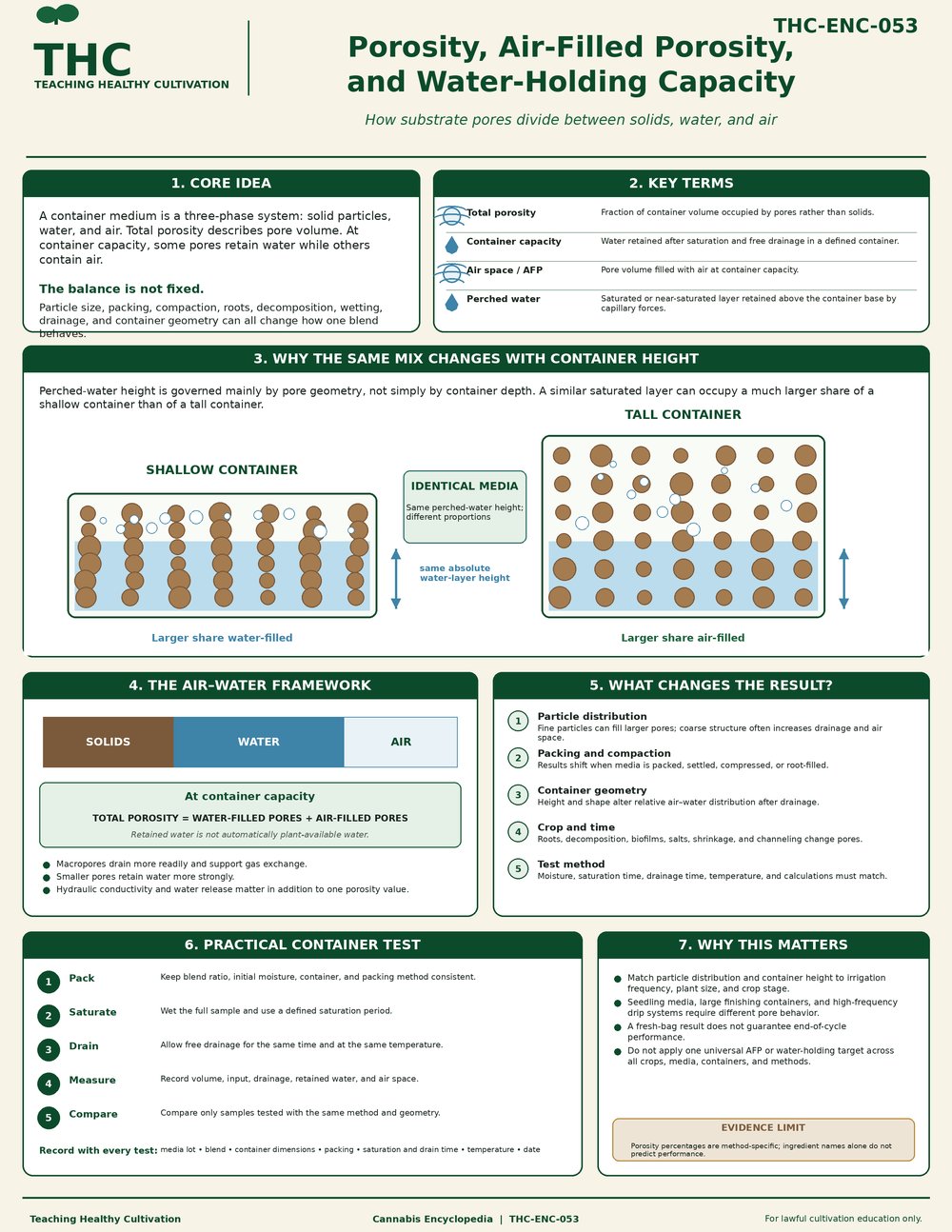
Substrate pores hold either water or gas. Large, connected pores drain readily and replenish oxygen; smaller pores retain water more strongly. Total porosity alone is incomplete because two mixes can have similar total pore volume but very different distributions between air and water.
Container capacity and air space depend on the container as well as the mix. For the same substrate, a taller column generally drains to a lower average water content and more air space than a shallow column. Adding drainage holes improves exit pathways but does not eliminate the capillary water profile.
Particle breakdown, compaction, root growth, biofilms, salts, and decomposition change pore geometry during production. Measurements on a fresh bag do not guarantee end-of-cycle behavior.
At a defined drained state, total porosity is the combined volume fraction of air-filled and water-filled pores. Air-filled porosity at container capacity is not equivalent to total porosity, and retained water at container capacity is not synonymous with water that roots can extract without stress. Drainage, adhesion to particles, matric potential and root distribution all contribute to the useful water-supply range.
The apparent perched-water region occurs because capillary retention opposes gravity in the packed pore network. A fixed substrate in a shallow pot commonly retains a greater average fraction of water after free drainage than the same substrate in a taller pot, even when both have open drainage outlets. Initial wetting, shrink-swell behavior, packing density and preferential flow can change the observed result.
Container-based gravimetric comparisons need clear reference conditions. Saturate a representative sample by a documented method, allow free drainage for a specified interval, weigh the same container, and compare subsequent weight loss under known conditions. Evaporation, plant transpiration, handling and changes in container tare mass must not be mistaken for the same process.
Why this matters in cultivation
- Match particle distribution and container height to irrigation strategy and plant size. Fine seedling media, large finishing containers, and high-frequency drip systems have different requirements.
- A practical container test can quantify saturated volume, drained volume, retained water, and air space. Use the same packing method and moisture history for batch comparisons.
- Worked comparison: two batches have the same advertised material blend but show different drainage and recovery. Check fill mass, mixing and pre-moistening, container geometry and drainage behavior before concluding that one ingredient caused the difference. Replicate the physical test with standardized packing.
- Use a reference empty-pot tare and repeatable drainage interval when tracking container mass. A drying trend can show water loss, but it does not alone demonstrate sufficient oxygen or quantify precisely how much remaining water is physiologically available.
Measure and record
Container
Nominal and measured volume, height, diameter, base shape, and drainage openings.
Media preparation
Lot, blend ratio, initial moisture, packing method, and compaction.
Physical test
Saturation volume, drained volume, container capacity, air space, and total porosity.
Crop change
Settling, shrinkage, root filling, channeling, and end-of-cycle retest.
Irrigation fit
Volume, frequency, runoff, dryback, and spatial uniformity.
Repeatable physical-property protocol
Record container volume and height, substrate dry/fill mass or packing density, prewetting method, time at saturation, free-drain interval, captured drainage, post-drain mass, ambient conditions and number of replicates. Report volumetric fractions with the exact test method.
Common misconceptions
Misconception: More perlite always means perfect aeration
Correction: Particle size, proportion, packing, container, and root growth determine the result.
Misconception: More drainage holes remove perched water
Correction: They improve exit but do not change the substrate’s capillary behavior by themselves.
Misconception: Water-holding capacity is a property of the bag alone
Correction: Container geometry and packing affect the measured value.
Misconception: Total porosity, air-filled porosity and plant-available water are interchangeable
Correction: these are distinct properties measured or inferred under specified states and methods.
Evidence limits and uncertainty
Different laboratories use related but nonidentical physical-property methods. Report the method, container, packing, and units with every value.
Simple drainage and container-mass tests are useful comparisons but are not direct measures of pore-size distribution, oxygen diffusion rate or root-extractable water potential. Cross-container comparisons require standardized packing, wetting and geometry; no single air-space percentage is universally optimal for cannabis.
Check your reasoning
- For "Porosity, Air-Filled Porosity, and Water-Holding Capacity", explain the mechanism behind this objective: Measure the air-water framework of a substrate and explain why the same mix behaves differently in different containers. Which observation or measurement would best test whether that mechanism is operating in the real crop?
- A learner claims, "More perlite always means perfect aeration" Use the lesson’s science and evidence limits to explain why that claim is unreliable, then name one observation or measurement that could separate the competing explanations.
- Applied case — Match particle distribution and container height to irrigation strategy and plant size. Fine seedling media, large finishing containers, and high-frequency drip systems have different requirements. Build a verification plan using the lesson’s record set (Container, Media preparation, Physical test). What would you compare before and after the action, and what result would make you revise the original interpretation?
Require lesson-specific evidence, not memorized universal targets. Open the rationales after you have written or discussed your own answer.
Answer rationale 1: Mechanism / workflow rationale
- A strong answer should connect the response to the lesson objective: Measure the air-water framework of a substrate and explain why the same mix behaves differently in different containers.
- Substrate pores hold either water or gas. Large, connected pores drain readily and replenish oxygen; smaller pores retain water more strongly. Total porosity alone is incomplete because two mixes can have similar total pore volume but very different distributions between air and water.
- Container capacity and air space depend on the container as well as the mix. For the same substrate, a taller column generally drains to a lower average water content and more air space than a shallow column. Adding drainage holes improves exit pathways but does not eliminate the capillary water profile.
- The most useful verification evidence includes Container: Nominal and measured volume, height, diameter, base shape, and drainage openings.
- Keep this limit explicit: Different laboratories use related but nonidentical physical-property methods. Report the method, container, packing, and units with every value.
Answer rationale 2: Misconception rationale
- The shortcut is unreliable because the lesson explicitly teaches a more conditional explanation.
- Representative misconception: More perlite always means perfect aeration: Particle size, proportion, packing, container, and root growth determine the result.
- Substrate pores hold either water or gas. Large, connected pores drain readily and replenish oxygen; smaller pores retain water more strongly. Total porosity alone is incomplete because two mixes can have similar total pore volume but very different distributions between air and water.
- A useful discriminator is Media preparation: Lot, blend ratio, initial moisture, packing method, and compaction.
- Do not overextend the conclusion beyond this limit: Different laboratories use related but nonidentical physical-property methods. Report the method, container, packing, and units with every value.
Answer rationale 3: Applied verification rationale
- In practice: Match particle distribution and container height to irrigation strategy and plant size. Fine seedling media, large finishing containers, and high-frequency drip systems have different requirements.
- Record before action: Container: Nominal and measured volume, height, diameter, base shape, and drainage openings.
- Also record: Media preparation: Lot, blend ratio, initial moisture, packing method, and compaction.
- After the action, repeat the same measurement or observation so the comparison is valid.
- Revise the interpretation if the result conflicts with the lesson limit or the expected response: Different laboratories use related but nonidentical physical-property methods. Report the method, container, packing, and units with every value.
Related lessons
Sources and evidence
- Nemali K. Greenhouse and Indoor Production of Horticultural Crops: Understanding the Pores of a Soilless Substrate. Purdue Extension HO-287-W. 2018. Open source
- Owen WG, Lopez RG. Commercial Greenhouse and Nursery Production: Evaluating Container Substrates and Their Components. Purdue Extension HO-255-W. 2015. Open source
- THC – Teaching Healthy Cultivation. Cannabis Plant Science Source Packet, version 1. Project source packet supplied by the publisher.
- Zhang H, Dunn B, Hu B. Greenhouse Growth Media Sampling, Testing and Interpretations. Oklahoma State University Extension HLA-6726. 2021. Open source
Downloads
No lesson-specific download is approved for this release. Use browser print/save-to-PDF when you need an offline reading copy.