Container Geometry, Root Restriction, and Transplanting
Explain how container volume, height, shape, and root occupancy affect water distribution, architecture, and transplant decisions.
Explain how container volume, height, shape, and root occupancy affect water distribution, architecture, and transplant decisions.
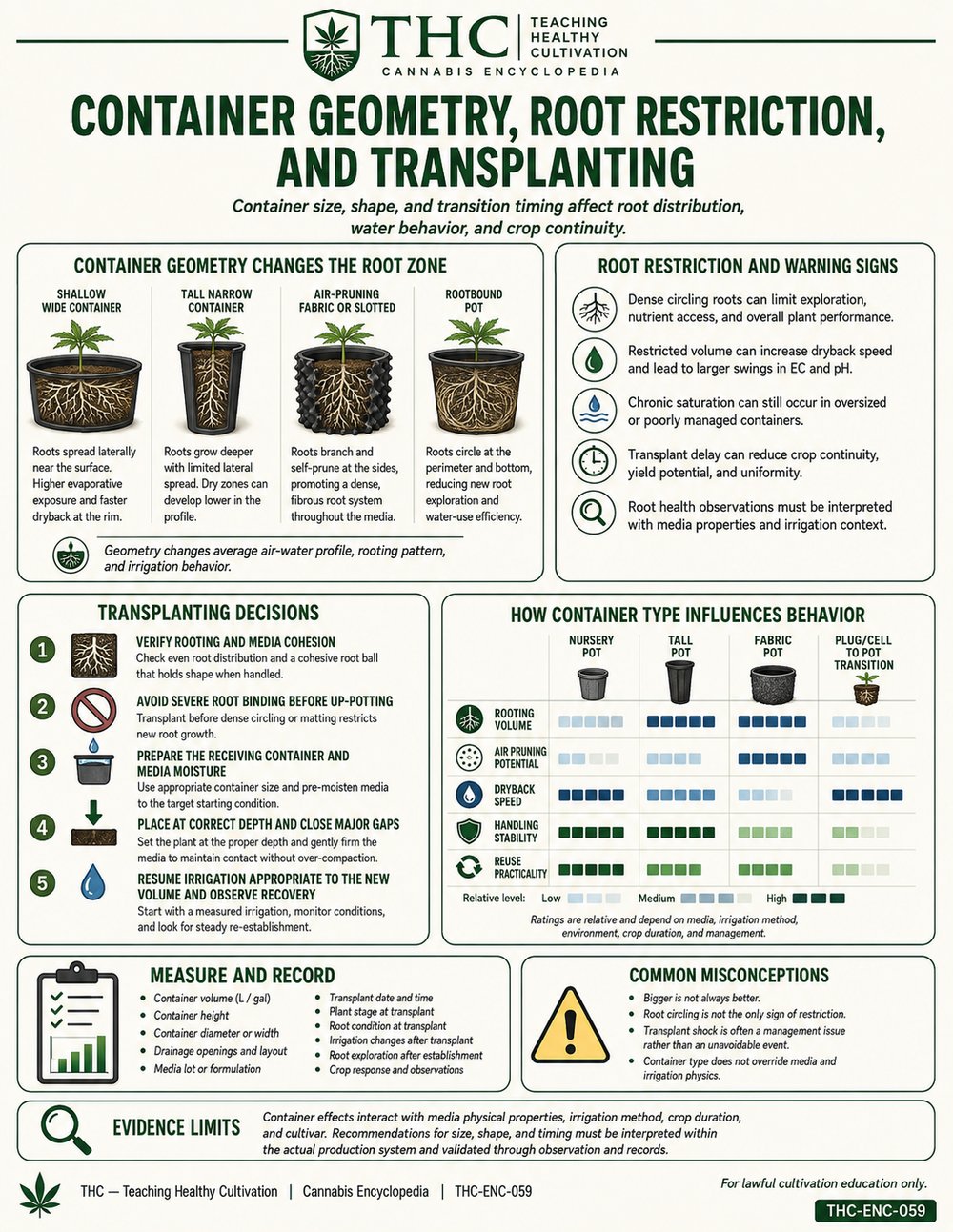
Core science
Container volume limits the space available for roots, water, air, and buffering. Shape matters as well: height changes drainage and average water retention; width changes horizontal exploration; taper and wall design affect circling and root extraction. Nominal volume alone does not describe the root environment.
Restriction can reduce root growth, alter root-to-shoot signaling, and make water and nutrient supply more dependent on frequent management. Dense roots can channel water around the plug or create sharply different moisture zones. Larger containers reduce some constraints but increase wet volume and may remain saturated when occupied by a small plant.
Successful transplanting requires physical contact and moisture continuity between the old root ball and new medium. Large differences in texture, wettability, EC, or moisture can trap roots in the original plug or create drought/saturation interfaces.
Figure THC-ENC-059. Container Geometry, Root Restriction, and Transplanting. Controlled educational visual for Volume 03; interpret observations and measurements within the lesson’s stated methods and evidence limits.
Why this matters in cultivation
- Transplant when the plug holds together and roots are actively exploring, before severe circling or repeated daily stress. Readiness is a combined root, shoot, irrigation, and schedule decision.
- Match the step-up size to plant demand and the grower’s ability to wet the new volume uniformly without keeping it chronically saturated.
Measure and record
Container
Actual volume, height, diameter, drainage, color/material, and prior use.
Root occupancy
Coverage by sector, circling, matting, root color, and plug cohesion.
Pretransplant
Plant age, shoot size, root-zone moisture, pH/EC, and last irrigation.
Procedure
Date, new medium/lot, hole preparation, depth, root disturbance, and irrigation.
Recovery
Wilt, water use, new growth, rooting into new media, and losses.
Common misconceptions
Misconception: Bigger containers are always safer
Correction: An oversized wet volume can be poorly aerated around a small root system.
Misconception: Roots instantly use all new media
Correction: Colonization takes time and follows suitable water, oxygen, and temperature.
Misconception: Transplant shock is unavoidable
Correction: Good timing, continuity, and handling can greatly reduce it.
Evidence limits and uncertainty
Cannabis-specific controlled studies isolating container shape and restriction are limited. Much operational guidance comes from general container horticulture and must be validated by cultivar and system.
Check your reasoning
- For "Container Geometry, Root Restriction, and Transplanting", explain the mechanism behind this objective: Explain how container volume, height, shape, and root occupancy affect water distribution, architecture, and transplant decisions. Which observation or measurement would best test whether that mechanism is operating in the real crop?
- A learner claims, "Bigger containers are always safer" Use the lesson’s science and evidence limits to explain why that claim is unreliable, then name one observation or measurement that could separate the competing explanations.
- Applied case — Transplant when the plug holds together and roots are actively exploring, before severe circling or repeated daily stress. Readiness is a combined root, shoot, irrigation, and schedule decision. Build a verification plan using the lesson’s record set (Container, Root occupancy, Pretransplant). What would you compare before and after the action, and what result would make you revise the original interpretation?
Require lesson-specific evidence, not memorized universal targets. Open the rationales after you have written or discussed your own answer.
Answer rationale 1: Mechanism / workflow rationale
- A strong answer should connect the response to the lesson objective: Explain how container volume, height, shape, and root occupancy affect water distribution, architecture, and transplant decisions.
- Container volume limits the space available for roots, water, air, and buffering. Shape matters as well: height changes drainage and average water retention; width changes horizontal exploration; taper and wall design affect circling and root extraction. Nominal volume alone does not describe the root environment.
- Restriction can reduce root growth, alter root-to-shoot signaling, and make water and nutrient supply more dependent on frequent management. Dense roots can channel water around the plug or create sharply different moisture zones. Larger containers reduce some constraints but increase wet volume and may remain saturated when occupied by a small plant.
- The most useful verification evidence includes Container: Actual volume, height, diameter, drainage, color/material, and prior use.
- Keep this limit explicit: Cannabis-specific controlled studies isolating container shape and restriction are limited. Much operational guidance comes from general container horticulture and must be validated by cultivar and system.
Answer rationale 2: Misconception rationale
- The shortcut is unreliable because the lesson explicitly teaches a more conditional explanation.
- Representative misconception: Bigger containers are always safer: An oversized wet volume can be poorly aerated around a small root system.
- Container volume limits the space available for roots, water, air, and buffering. Shape matters as well: height changes drainage and average water retention; width changes horizontal exploration; taper and wall design affect circling and root extraction. Nominal volume alone does not describe the root environment.
- A useful discriminator is Root occupancy: Coverage by sector, circling, matting, root color, and plug cohesion.
- Do not overextend the conclusion beyond this limit: Cannabis-specific controlled studies isolating container shape and restriction are limited. Much operational guidance comes from general container horticulture and must be validated by cultivar and system.
Answer rationale 3: Applied verification rationale
- In practice: Transplant when the plug holds together and roots are actively exploring, before severe circling or repeated daily stress. Readiness is a combined root, shoot, irrigation, and schedule decision.
- Record before action: Container: Actual volume, height, diameter, drainage, color/material, and prior use.
- Also record: Root occupancy: Coverage by sector, circling, matting, root color, and plug cohesion.
- After the action, repeat the same measurement or observation so the comparison is valid.
- Revise the interpretation if the result conflicts with the lesson limit or the expected response: Cannabis-specific controlled studies isolating container shape and restriction are limited. Much operational guidance comes from general container horticulture and must be validated by cultivar and system.
Related lessons
Sources and evidence
- Owen WG, Lopez RG. Commercial Greenhouse and Nursery Production: Evaluating Container Substrates and Their Components. Purdue Extension HO-255-W. 2015. Open source
- Nemali K. Greenhouse and Indoor Production of Horticultural Crops: Understanding the Pores of a Soilless Substrate. Purdue Extension HO-287-W. 2018. Open source
- THC – Teaching Healthy Cultivation. Cannabis Plant Science Source Packet, version 1. Project source packet supplied by the publisher.
- Poorter H, Bühler J, van Dusschoten D, Climent J, Postma JA. Pot size matters: a meta-analysis of the effects of rooting volume on plant growth. Functional Plant Biology. 2012;39(11):839–850. doi:10.1071/FP12049. Open abstract
Downloads
No lesson-specific download is approved for this release. Use browser print/save-to-PDF when you need an offline reading copy.