Media Testing, Batch Qualification, and Reuse Decisions
Build a controlled media-qualification program that connects sampling, physical and chemical tests, crop trials, contamination risk, and release decisions.
Build a controlled media-qualification program that connects sampling, physical and chemical tests, crop trials, contamination risk, and release decisions.
Core science
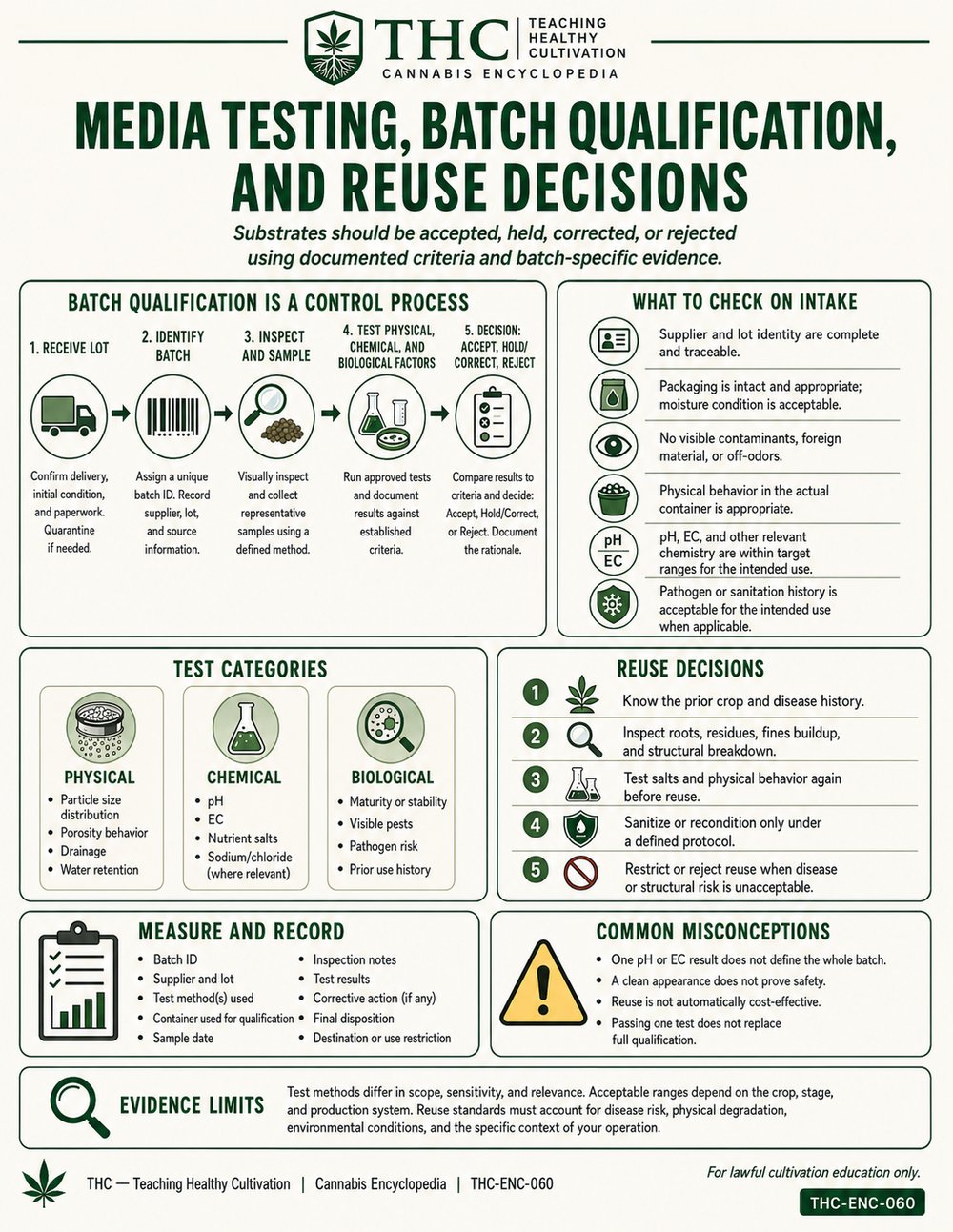
Media qualification begins before planting. Confirm supplier, formulation, lot, packaging integrity, storage, moisture, odor, pests, foreign material, and label claims. Then test properties tied to the intended system: pH, EC, air space, container capacity, bulk density, particle distribution, nutrients, sodium/chloride, maturity, or pathogens as applicable.
Extraction methods are not interchangeable. Pour-through, saturated media extract, and 1:2 dilution use different sample preparation and produce different numerical ranges. Trend comparisons require the same method, meter calibration, timing, moisture state, container, and sampling location.
Reuse is a risk decision, not an automatic sustainability win. Residual roots, salts, unbalanced nutrients, decomposed particles, pests, pathogens, pesticide residues, and changed wettability must be weighed against cost, waste, treatment feasibility, legal limits, and crop value. Mixing unqualified used media into a new lot hides the history rather than removing it.
Figure THC-ENC-060. Media Testing, Batch Qualification, and Reuse Decisions. Controlled educational visual for Volume 03; interpret observations and measurements within the lesson’s stated methods and evidence limits.
Why this matters in cultivation
- Set written release, hold, recondition, downgrade, and reject criteria before results arrive. A small biological crop trial can reveal issues that chemical tests miss.
- If reuse is allowed, assign a new batch ID and document source crop, sanitation or treatment, amendments, retesting, and destination. Never send suspect disease media into clean propagation.
Measure and record
Identity and chain
Supplier, formula, lot, receipt, storage, sampler, date, and destination.
Sampling
Plan, number of increments, locations, composite method, container, and preservation.
Test panel
Method-specific pH/EC, physical properties, nutrients, contaminants, maturity, and pathogens.
Decision
Specification, result, release/hold/reject status, reviewer, and rationale.
Reuse/CAPA
Source history, treatment, amendment, retest, restricted use, follow-up, and prevention.
Common misconceptions
Misconception: One runoff reading qualifies a media lot
Correction: It samples one container under one method and moisture history.
Misconception: A sanitized container makes used media clean
Correction: The medium retains biological, chemical, and physical history.
Misconception: Different pH/EC extraction methods should match
Correction: They create different dilutions and accepted interpretation ranges.
Evidence limits and uncertainty
Specifications must be tailored to crop, container, irrigation, laboratory method, and jurisdiction. This volume does not establish universal cannabis pass/fail numbers.
Check your reasoning
- For "Media Testing, Batch Qualification, and Reuse Decisions", explain the mechanism behind this objective: Build a controlled media-qualification program that connects sampling, physical and chemical tests, crop trials, contamination risk, and release decisions. Which observation or measurement would best test whether that mechanism is operating in the real crop?
- A learner claims, "One runoff reading qualifies a media lot" Use the lesson’s science and evidence limits to explain why that claim is unreliable, then name one observation or measurement that could separate the competing explanations.
- Applied case — Set written release, hold, recondition, downgrade, and reject criteria before results arrive. A small biological crop trial can reveal issues that chemical tests miss. Build a verification plan using the lesson’s record set (Identity and chain, Sampling, Test panel). What would you compare before and after the action, and what result would make you revise the original interpretation?
Require lesson-specific evidence, not memorized universal targets. Open the rationales after you have written or discussed your own answer.
Answer rationale 1: Mechanism / workflow rationale
- A strong answer should connect the response to the lesson objective: Build a controlled media-qualification program that connects sampling, physical and chemical tests, crop trials, contamination risk, and release decisions.
- Media qualification begins before planting. Confirm supplier, formulation, lot, packaging integrity, storage, moisture, odor, pests, foreign material, and label claims. Then test properties tied to the intended system: pH, EC, air space, container capacity, bulk density, particle distribution, nutrients, sodium/chloride, maturity, or pathogens as applicable.
- Extraction methods are not interchangeable. Pour-through, saturated media extract, and 1:2 dilution use different sample preparation and produce different numerical ranges. Trend comparisons require the same method, meter calibration, timing, moisture state, container, and sampling location.
- The most useful verification evidence includes Identity and chain: Supplier, formula, lot, receipt, storage, sampler, date, and destination.
- Keep this limit explicit: Specifications must be tailored to crop, container, irrigation, laboratory method, and jurisdiction. This volume does not establish universal cannabis pass/fail numbers.
Answer rationale 2: Misconception rationale
- The shortcut is unreliable because the lesson explicitly teaches a more conditional explanation.
- Representative misconception: One runoff reading qualifies a media lot: It samples one container under one method and moisture history.
- Media qualification begins before planting. Confirm supplier, formulation, lot, packaging integrity, storage, moisture, odor, pests, foreign material, and label claims. Then test properties tied to the intended system: pH, EC, air space, container capacity, bulk density, particle distribution, nutrients, sodium/chloride, maturity, or pathogens as applicable.
- A useful discriminator is Sampling: Plan, number of increments, locations, composite method, container, and preservation.
- Do not overextend the conclusion beyond this limit: Specifications must be tailored to crop, container, irrigation, laboratory method, and jurisdiction. This volume does not establish universal cannabis pass/fail numbers.
Answer rationale 3: Applied verification rationale
- In practice: Set written release, hold, recondition, downgrade, and reject criteria before results arrive. A small biological crop trial can reveal issues that chemical tests miss.
- Record before action: Identity and chain: Supplier, formula, lot, receipt, storage, sampler, date, and destination.
- Also record: Sampling: Plan, number of increments, locations, composite method, container, and preservation.
- After the action, repeat the same measurement or observation so the comparison is valid.
- Revise the interpretation if the result conflicts with the lesson limit or the expected response: Specifications must be tailored to crop, container, irrigation, laboratory method, and jurisdiction. This volume does not establish universal cannabis pass/fail numbers.
Related lessons
Sources and evidence
- Camberato DM, Lopez RG, Mickelbart MV. Commercial Greenhouse Production: pH and Electrical Conductivity Measurements in Soilless Substrates. Purdue Extension HO-237-W. 2009. Open source
- Owen WG, Lopez RG. Commercial Greenhouse and Nursery Production: Evaluating Container Substrates and Their Components. Purdue Extension HO-255-W. 2015. Open source
- THC – Teaching Healthy Cultivation. Cannabis Plant Science Source Packet, version 1. Project source packet supplied by the publisher.
- Punja ZK. Emerging diseases of Cannabis sativa and sustainable management. Pest Management Science. 2021;77(9):3857–3870. doi:10.1002/ps.6307. Open source
- Zhang H, Dunn B, Hu B. Greenhouse Growth Media Sampling, Testing and Interpretations. Oklahoma State University Extension HLA-6726. 2021. Open source
Downloads
No lesson-specific download is approved for this release. Use browser print/save-to-PDF when you need an offline reading copy.