Rockwool, Perlite, and Inert Media
Compare low-buffer media by physical function, handling, chemistry, and system risk rather than treating ‘inert’ as maintenance-free.
Compare low-buffer media by physical function, handling, chemistry, and system risk rather than treating ‘inert’ as maintenance-free.
Core science
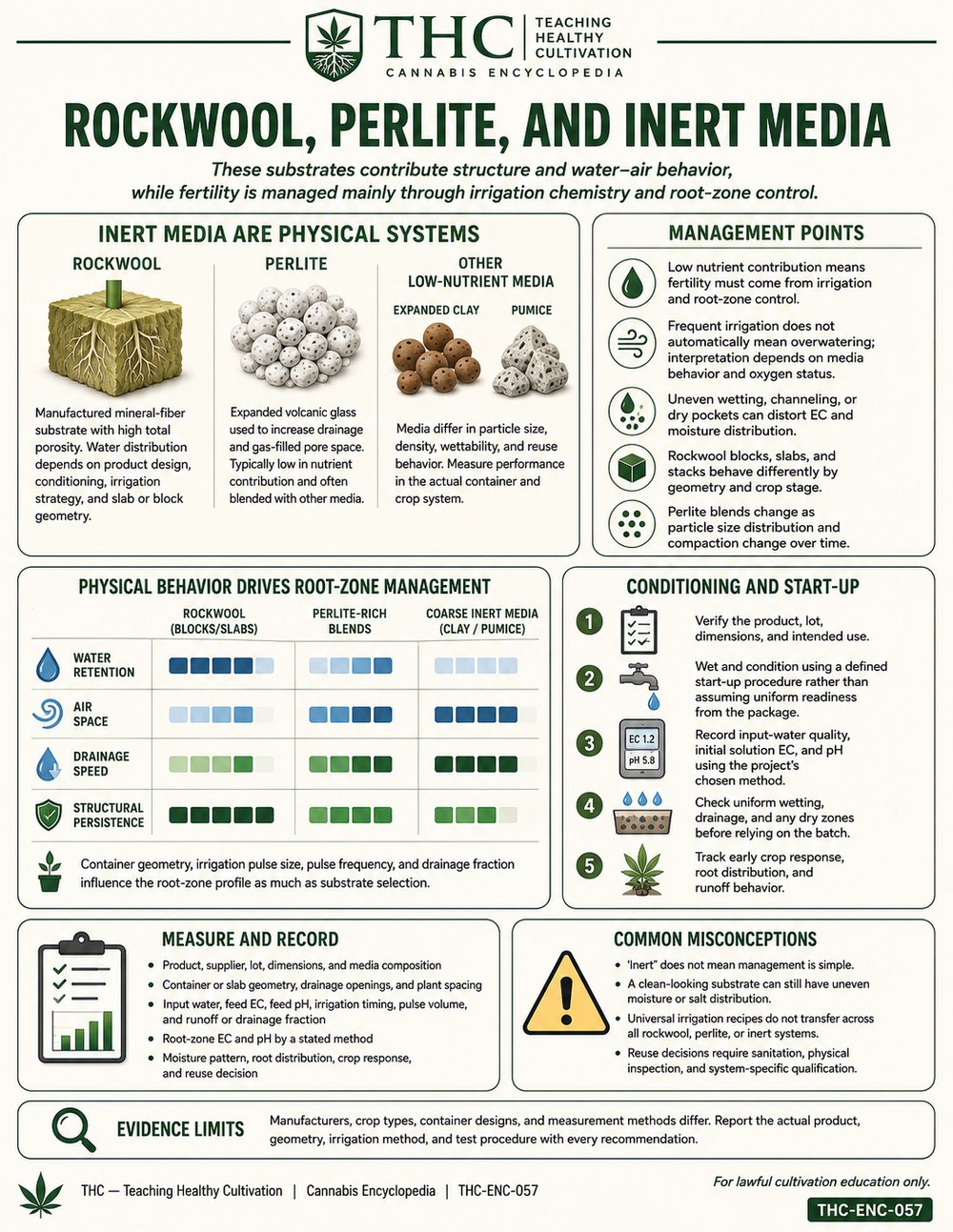
Rockwool provides a manufactured pore network with substantial water retention and air space when irrigation is controlled. Perlite provides large pores and low bulk density but its behavior depends on grade, particle breakage, container, and whether it is blended or used alone. Neither material is chemically invisible.
Low CEC means root-zone chemistry can respond rapidly to the delivered solution. That precision is useful, but it also reduces buffering against dosing errors, pump failures, pH drift, and dryback. Salts can accumulate where water evaporates or distribution is uneven.
Rockwool and perlite do not supply balanced nutrition. Initial conditioning, irrigation pattern, drainage, root density, and sanitation determine performance. Dust exposure during dry handling requires manufacturer-recommended respiratory and eye protection.
Physical water retention and actual plant access to water are distinct. A cube or slab can hold water in pores while its wetting pattern, root distribution, and drainage configuration still produce zones with different oxygen and ionic conditions. Gravimetric trends indicate changing container water mass, but do not directly resolve within-slab gradients or root-surface oxygen concentration. To interpret a treatment, record irrigation volume, interval, input and drainage EC and pH, slab or root-zone temperature, and where each sensor or sample was taken. Compare matched units before attributing uneven growth to the media material itself.
Why this matters in cultivation
- Qualify slab, cube, or aggregate dimensions and measure saturated/drained behavior in the actual container. Do not infer water status from surface color alone.
- Track each emitter and drainage path. In low-buffer media, a clogged line or concentrated stock error can damage roots quickly.
- If one slab dries or accumulates salts faster than a neighboring slab, compare delivered volume, emitter flow, drainage fraction, slab size, root distribution, and sensor position before increasing feed strength. Run paired tests under the same irrigation schedule and record repeated input and drainage measurements. This helps distinguish inconsistent water delivery from the physical response of the substrate.
Measure and record
Material
Type, brand, lot, dimensions or grade, density, and preconditioning instructions.
Preparation
Water quality, pH/EC, soak volume/time, drainage, and PPE.
Hydraulics
Emitter flow, distribution uniformity, saturated mass, dryback, and runoff.
Chemistry
Input and root-zone pH/EC with method and calibration.
Disposition
Root condition, contamination, reuse feasibility, recycling, and waste route.
Comparative evidence protocol
Record exact product name, slab or cube dimensions, installation orientation, conditioning procedure, and pre-irrigation mass. Where practical, compare repeated container weights and representative drainage samples from matched units over time. Document when readings were collected relative to each irrigation event, since time and sampling location can change the interpretation.
Common misconceptions
Misconception: Inert means no pH or EC management
Correction: Low buffering makes solution management more—not less—important.
Misconception: Rockwool cannot be overwatered
Correction: Persistent saturation can reduce gas exchange despite internal pore space.
Misconception: Any perlite grade behaves the same
Correction: Particle size and breakage change air-water properties.
Evidence limits and uncertainty
Manufacturer products differ in fiber orientation, density, binders, wetting treatment, and geometry. Report the exact product and test the production unit.
Low exchange capacity should not be interpreted as an absolute absence of chemical interactions, and a reservoir EC reading does not describe every local salt concentration near roots. Findings from one mineral-wool product, emitter pattern, or container geometry cannot automatically be transferred to another brand or production layout.
Check your reasoning
- For "Rockwool, Perlite, and Inert Media", explain the mechanism behind this objective: Compare low-buffer media by physical function, handling, chemistry, and system risk rather than treating ‘inert’ as maintenance-free. Which observation or measurement would best test whether that mechanism is operating in the real crop?
- A learner claims, "Inert means no pH or EC management" Use the lesson’s science and evidence limits to explain why that claim is unreliable, then name one observation or measurement that could separate the competing explanations.
- Applied case — Qualify slab, cube, or aggregate dimensions and measure saturated/drained behavior in the actual container. Do not infer water status from surface color alone. Build a verification plan using the lesson’s record set (Material, Preparation, Hydraulics). What would you compare before and after the action, and what result would make you revise the original interpretation?
Require lesson-specific evidence, not memorized universal targets. Open the rationales after you have written or discussed your own answer.
Answer rationale 1: Mechanism / workflow rationale
- A strong answer should connect the response to the lesson objective: Compare low-buffer media by physical function, handling, chemistry, and system risk rather than treating ‘inert’ as maintenance-free.
- Rockwool provides a manufactured pore network with substantial water retention and air space when irrigation is controlled. Perlite provides large pores and low bulk density but its behavior depends on grade, particle breakage, container, and whether it is blended or used alone. Neither material is chemically invisible.
- Low CEC means root-zone chemistry can respond rapidly to the delivered solution. That precision is useful, but it also reduces buffering against dosing errors, pump failures, pH drift, and dryback. Salts can accumulate where water evaporates or distribution is uneven.
- The most useful verification evidence includes Material: Type, brand, lot, dimensions or grade, density, and preconditioning instructions.
- Keep this limit explicit: Manufacturer products differ in fiber orientation, density, binders, wetting treatment, and geometry. Report the exact product and test the production unit.
Answer rationale 2: Misconception rationale
- The shortcut is unreliable because the lesson explicitly teaches a more conditional explanation.
- Representative misconception: Inert means no pH or EC management: Low buffering makes solution management more—not less—important.
- Rockwool provides a manufactured pore network with substantial water retention and air space when irrigation is controlled. Perlite provides large pores and low bulk density but its behavior depends on grade, particle breakage, container, and whether it is blended or used alone. Neither material is chemically invisible.
- A useful discriminator is Preparation: Water quality, pH/EC, soak volume/time, drainage, and PPE.
- Do not overextend the conclusion beyond this limit: Manufacturer products differ in fiber orientation, density, binders, wetting treatment, and geometry. Report the exact product and test the production unit.
Answer rationale 3: Applied verification rationale
- In practice: Qualify slab, cube, or aggregate dimensions and measure saturated/drained behavior in the actual container. Do not infer water status from surface color alone.
- Record before action: Material: Type, brand, lot, dimensions or grade, density, and preconditioning instructions.
- Also record: Preparation: Water quality, pH/EC, soak volume/time, drainage, and PPE.
- After the action, repeat the same measurement or observation so the comparison is valid.
- Revise the interpretation if the result conflicts with the lesson limit or the expected response: Manufacturer products differ in fiber orientation, density, binders, wetting treatment, and geometry. Report the exact product and test the production unit.
Related lessons
Sources and evidence
- Owen WG, Lopez RG. Commercial Greenhouse and Nursery Production: Evaluating Container Substrates and Their Components. Purdue Extension HO-255-W. 2015. Open source
- Dunn B. Hydroponics. Oklahoma State University Extension HLA-6442. Revised 2025. Open source
- THC – Teaching Healthy Cultivation. Cannabis Plant Science Source Packet, version 1. Project source packet supplied by the publisher.
- Thakulla D, Dunn B, Hu B. Soilless Growing Mediums. Oklahoma State University Extension HLA-6728. 2021. Open source
Downloads
No lesson-specific download is approved for this release. Use browser print/save-to-PDF when you need an offline reading copy.