Soil Texture, Structure, and Aggregation
Distinguish mineral particle-size composition from soil structure and explain how both influence roots, water, air, and management.
Distinguish mineral particle-size composition from soil structure and explain how both influence roots, water, air, and management.
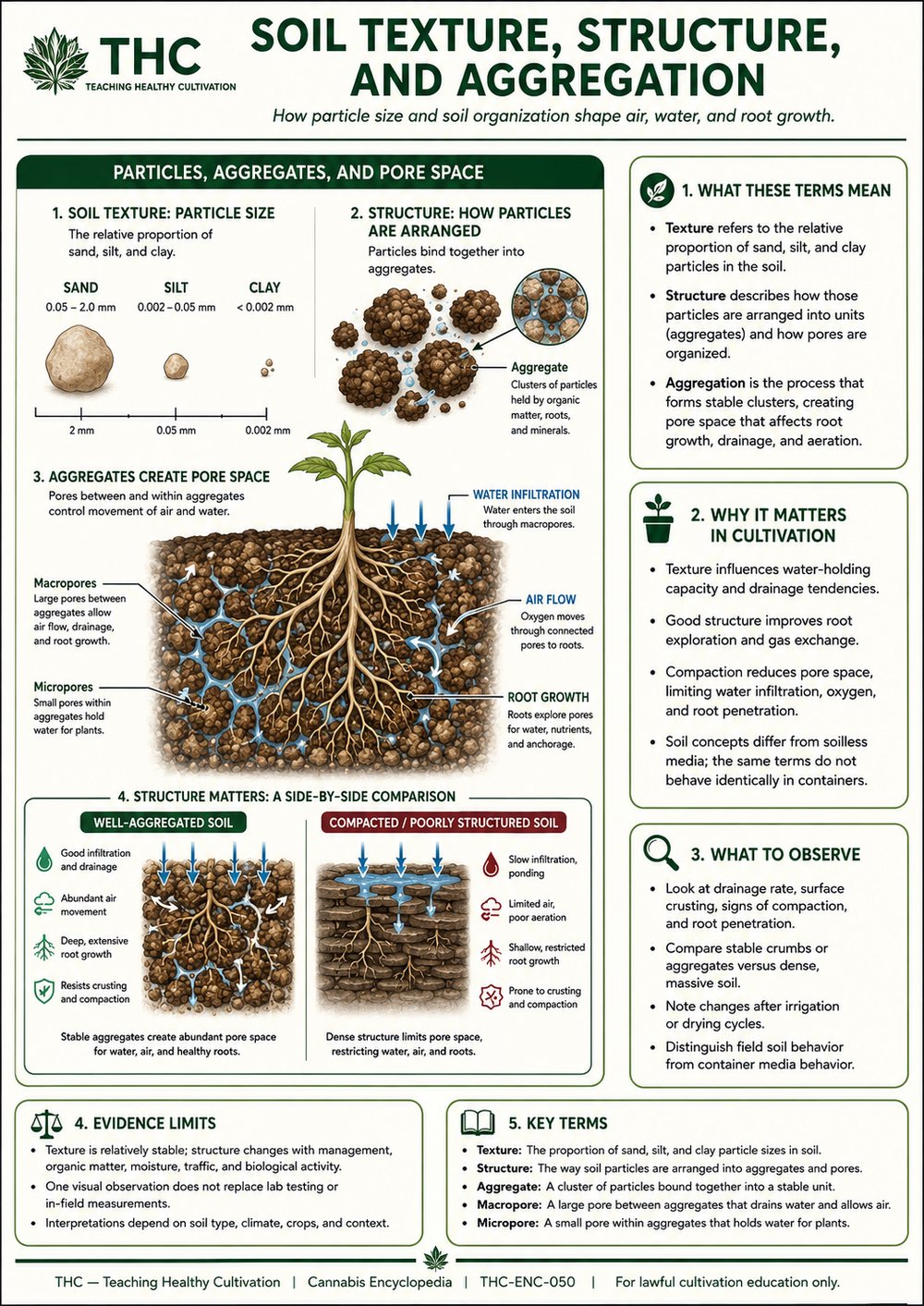
Core science
Texture is a mineral-soil property and does not change quickly through normal amendment. Sand-sized particles are relatively large, clay-sized particles are extremely small, and silt is intermediate. Texture influences surface area, drainage, water retention, and nutrient-holding behavior, but it does not alone describe the pore network roots experience.
Structure describes how particles assemble into aggregates and connected pores. Organic matter, roots, fungal hyphae, wetting-drying cycles, tillage, compaction, sodium, and biological activity can strengthen or weaken aggregation. Two soils with similar texture can behave differently because their structure and organic matter differ.
Container media should not be classified by field-soil texture triangles when they consist mainly of peat, coir, bark, perlite, or compost. Their properties are measured as substrate porosity, air space, container capacity, particle distribution, and bulk density.
Why this matters in cultivation
- For outdoor cultivation, inspect drainage, compaction, rooting depth, restrictive layers, slope, and infiltration before planting. Amending a small clay planting hole with large amounts of coarse material can create discontinuities rather than fixing the field.
- Avoid working wet soil when it smears and compacts. Protect structure with organic inputs, roots, reduced traffic, and management suited to the site.
Measure and record
Site
Location, slope, prior use, drainage class, and visible restrictive layers.
Soil test
Texture or lab classification, pH, organic matter, CEC, and nutrient results.
Physical observations
Infiltration, aggregate stability, compaction, bulk density, and rooting depth.
Weather/irrigation
Rainfall, irrigation, ponding duration, and erosion.
Management
Tillage, traffic, mulch, cover crop, amendment, and response.
Common misconceptions
Misconception: Adding sand always fixes clay
Correction: Poor ratios can create a dense mix; site-scale structure and drainage need diagnosis.
Misconception: Texture and structure are the same
Correction: Texture is particle-size composition; structure is particle arrangement.
Misconception: Potting mix is simply soil
Correction: Soilless substrates require different physical-property terminology and tests.
Evidence limits and uncertainty
Field behavior varies with mineralogy, climate, management history, depth, and sampling. A jar test is educational but not equivalent to a laboratory particle-size analysis.
Check your reasoning
- For "Soil Texture, Structure, and Aggregation", explain the mechanism behind this objective: Distinguish mineral particle-size composition from soil structure and explain how both influence roots, water, air, and management. Which observation or measurement would best test whether that mechanism is operating in the real crop?
- A learner claims, "Adding sand always fixes clay" Use the lesson’s science and evidence limits to explain why that claim is unreliable, then name one observation or measurement that could separate the competing explanations.
- Applied case — For outdoor cultivation, inspect drainage, compaction, rooting depth, restrictive layers, slope, and infiltration before planting. Amending a small clay planting hole with large amounts of coarse material can create discontinuities rather than fixing the field. Build a verification plan using the lesson’s record set (Site, Soil test, Physical observations). What would you compare before and after the action, and what result would make you revise the original interpretation?
Require lesson-specific evidence, not memorized universal targets. Open the rationales after you have written or discussed your own answer.
Answer rationale 1: Mechanism / workflow rationale
- A strong answer should connect the response to the lesson objective: Distinguish mineral particle-size composition from soil structure and explain how both influence roots, water, air, and management.
- Texture is a mineral-soil property and does not change quickly through normal amendment. Sand-sized particles are relatively large, clay-sized particles are extremely small, and silt is intermediate. Texture influences surface area, drainage, water retention, and nutrient-holding behavior, but it does not alone describe the pore network roots experience.
- Structure describes how particles assemble into aggregates and connected pores. Organic matter, roots, fungal hyphae, wetting-drying cycles, tillage, compaction, sodium, and biological activity can strengthen or weaken aggregation. Two soils with similar texture can behave differently because their structure and organic matter differ.
- The most useful verification evidence includes Site: Location, slope, prior use, drainage class, and visible restrictive layers.
- Keep this limit explicit: Field behavior varies with mineralogy, climate, management history, depth, and sampling. A jar test is educational but not equivalent to a laboratory particle-size analysis.
Answer rationale 2: Misconception rationale
- The shortcut is unreliable because the lesson explicitly teaches a more conditional explanation.
- Representative misconception: Adding sand always fixes clay: Poor ratios can create a dense mix; site-scale structure and drainage need diagnosis.
- Texture is a mineral-soil property and does not change quickly through normal amendment. Sand-sized particles are relatively large, clay-sized particles are extremely small, and silt is intermediate. Texture influences surface area, drainage, water retention, and nutrient-holding behavior, but it does not alone describe the pore network roots experience.
- A useful discriminator is Soil test: Texture or lab classification, pH, organic matter, CEC, and nutrient results.
- Do not overextend the conclusion beyond this limit: Field behavior varies with mineralogy, climate, management history, depth, and sampling. A jar test is educational but not equivalent to a laboratory particle-size analysis.
Answer rationale 3: Applied verification rationale
- In practice: For outdoor cultivation, inspect drainage, compaction, rooting depth, restrictive layers, slope, and infiltration before planting. Amending a small clay planting hole with large amounts of coarse material can create discontinuities rather than fixing the field.
- Record before action: Site: Location, slope, prior use, drainage class, and visible restrictive layers.
- Also record: Soil test: Texture or lab classification, pH, organic matter, CEC, and nutrient results.
- After the action, repeat the same measurement or observation so the comparison is valid.
- Revise the interpretation if the result conflicts with the lesson limit or the expected response: Field behavior varies with mineralogy, climate, management history, depth, and sampling. A jar test is educational but not equivalent to a laboratory particle-size analysis.
Related lessons
Sources and evidence
- THC – Teaching Healthy Cultivation. Cannabis Plant Science Source Packet, version 1. Project source packet supplied by the publisher.
- Owen WG, Lopez RG. Commercial Greenhouse and Nursery Production: Evaluating Container Substrates and Their Components. Purdue Extension HO-255-W. 2015. Open source
- USDA Natural Resources Conservation Service. Soil Survey Manual. Agriculture Handbook No. 18. 2017. Official technical manual. Open source
Downloads
No lesson-specific download is approved for this release. Use browser print/save-to-PDF when you need an offline reading copy.