Organic Matter, Humus, and Carbon Cycling
Explain how organic inputs decompose and distinguish measurable organic matter from the loosely used term humus.
Explain how organic inputs decompose and distinguish measurable organic matter from the loosely used term humus.
Core science
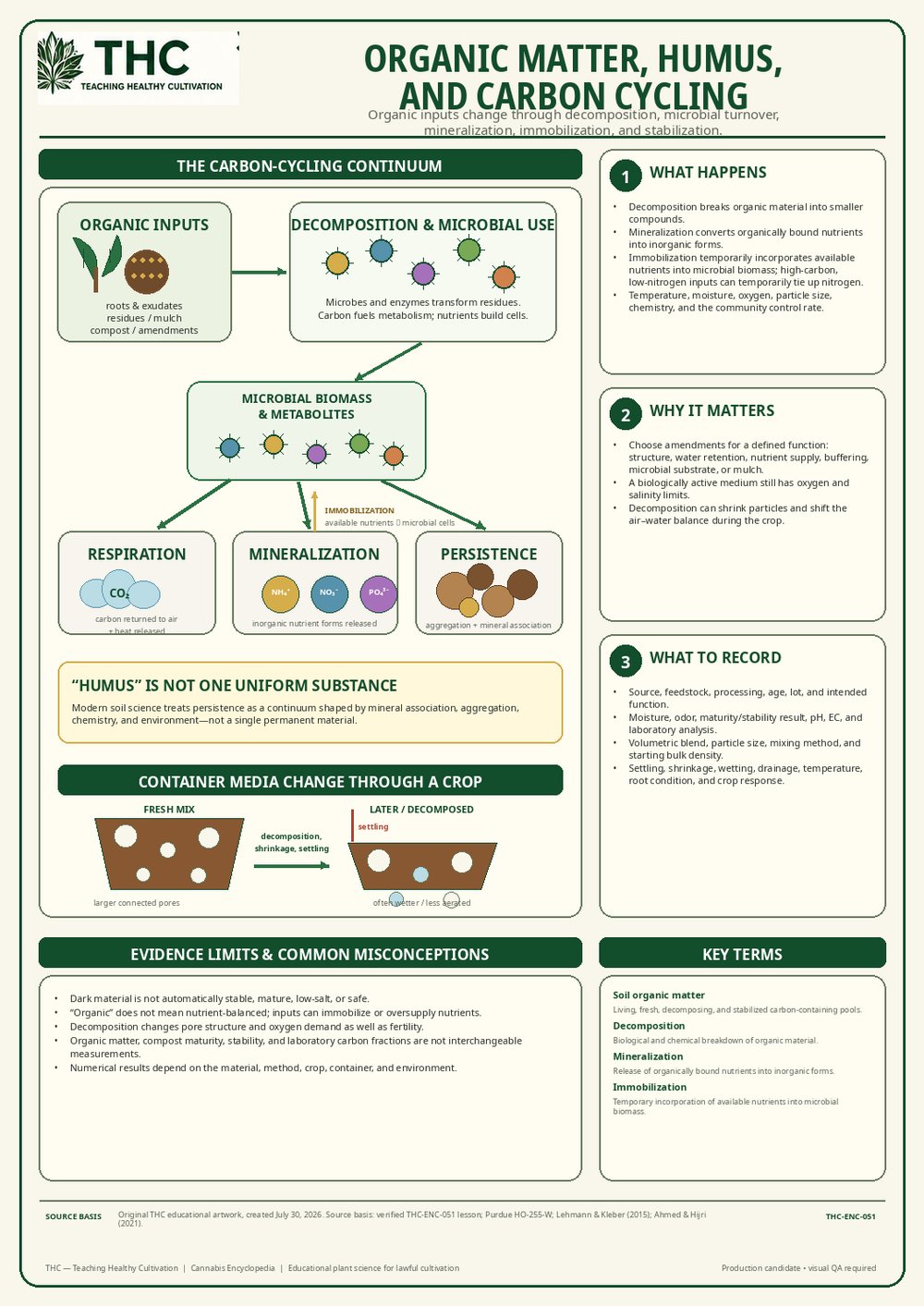
Organic matter includes living organisms, residues, roots, exudates, microbial products, and more persistent compounds. ‘Humus’ is widely used for dark, stabilized material, but modern soil science treats stability as a continuum shaped by mineral association, aggregation, chemistry, and environment rather than one uniform substance.
Microorganisms use organic carbon for energy and require nutrients to build cells. High-carbon, low-nitrogen inputs can temporarily immobilize nitrogen; more decomposed materials can release nutrients. Temperature, moisture, oxygen, particle size, chemistry, and community composition control the rate.
In containers, decomposition can shrink organic particles and shift the pore network during the crop. An initially airy mix can become wetter and less aerated. Compost and living-soil systems therefore require batch control, maturity assessment, and physical-property monitoring, not only nutrient recipes.
Figure THC-ENC-051. Organic Matter, Humus, and Carbon Cycling. Original THC educational artwork. Interpret observations and measurements within the lesson’s stated methods and evidence limits.
Why this matters in cultivation
- Choose amendments for a defined function: structure, water retention, nutrient supply, buffering, microbial substrate, or mulch. One product rarely performs all roles without tradeoffs.
- Track volume loss, settling, irrigation behavior, and EC through the crop. A biologically active medium is still subject to oxygen and salinity limits.
Measure and record
Material
Source, feedstock, processing, age, lot, and intended function.
Quality
Moisture, odor, stability/maturity result, pH, EC, and laboratory analysis.
Blend
Volumetric proportion, particle size, mixing method, and starting bulk density.
Crop behavior
Settling, shrinkage, wetting, drainage, temperature, and root condition.
Nutrient response
Input program, media/tissue tests, deficiency pattern, and corrective action.
Common misconceptions
Misconception: Dark material is automatically stable humus
Correction: Color does not establish maturity, stability, salinity, or safety.
Misconception: Organic means nutrient-balanced
Correction: Organic inputs vary widely and can immobilize or oversupply nutrients.
Misconception: Decomposition only adds fertility
Correction: It also changes volume, porosity, oxygen demand, and disease risk.
Evidence limits and uncertainty
Operational terms and laboratory methods differ. Compost maturity, stability, organic matter, and carbon fractions are not interchangeable measurements.
Check your reasoning
- For "Organic Matter, Humus, and Carbon Cycling", explain the mechanism behind this objective: Explain how organic inputs decompose and distinguish measurable organic matter from the loosely used term humus. Which observation or measurement would best test whether that mechanism is operating in the real crop?
- A learner claims, "Dark material is automatically stable humus" Use the lesson’s science and evidence limits to explain why that claim is unreliable, then name one observation or measurement that could separate the competing explanations.
- Applied case — Choose amendments for a defined function: structure, water retention, nutrient supply, buffering, microbial substrate, or mulch. One product rarely performs all roles without tradeoffs. Build a verification plan using the lesson’s record set (Material, Quality, Blend). What would you compare before and after the action, and what result would make you revise the original interpretation?
Require lesson-specific evidence, not memorized universal targets. Open the rationales after you have written or discussed your own answer.
Answer rationale 1: Mechanism / workflow rationale
- A strong answer should connect the response to the lesson objective: Explain how organic inputs decompose and distinguish measurable organic matter from the loosely used term humus.
- Organic matter includes living organisms, residues, roots, exudates, microbial products, and more persistent compounds. ‘Humus’ is widely used for dark, stabilized material, but modern soil science treats stability as a continuum shaped by mineral association, aggregation, chemistry, and environment rather than one uniform substance.
- Microorganisms use organic carbon for energy and require nutrients to build cells. High-carbon, low-nitrogen inputs can temporarily immobilize nitrogen; more decomposed materials can release nutrients. Temperature, moisture, oxygen, particle size, chemistry, and community composition control the rate.
- The most useful verification evidence includes Material: Source, feedstock, processing, age, lot, and intended function.
- Keep this limit explicit: Operational terms and laboratory methods differ. Compost maturity, stability, organic matter, and carbon fractions are not interchangeable measurements.
Answer rationale 2: Misconception rationale
- The shortcut is unreliable because the lesson explicitly teaches a more conditional explanation.
- Representative misconception: Dark material is automatically stable humus: Color does not establish maturity, stability, salinity, or safety.
- Organic matter includes living organisms, residues, roots, exudates, microbial products, and more persistent compounds. ‘Humus’ is widely used for dark, stabilized material, but modern soil science treats stability as a continuum shaped by mineral association, aggregation, chemistry, and environment rather than one uniform substance.
- A useful discriminator is Quality: Moisture, odor, stability/maturity result, pH, EC, and laboratory analysis.
- Do not overextend the conclusion beyond this limit: Operational terms and laboratory methods differ. Compost maturity, stability, organic matter, and carbon fractions are not interchangeable measurements.
Answer rationale 3: Applied verification rationale
- In practice: Choose amendments for a defined function: structure, water retention, nutrient supply, buffering, microbial substrate, or mulch. One product rarely performs all roles without tradeoffs.
- Record before action: Material: Source, feedstock, processing, age, lot, and intended function.
- Also record: Quality: Moisture, odor, stability/maturity result, pH, EC, and laboratory analysis.
- After the action, repeat the same measurement or observation so the comparison is valid.
- Revise the interpretation if the result conflicts with the lesson limit or the expected response: Operational terms and laboratory methods differ. Compost maturity, stability, organic matter, and carbon fractions are not interchangeable measurements.
Related lessons
Sources and evidence
- THC – Teaching Healthy Cultivation. Cannabis Plant Science Source Packet, version 1. Project source packet supplied by the publisher.
- Owen WG, Lopez RG. Commercial Greenhouse and Nursery Production: Evaluating Container Substrates and Their Components. Purdue Extension HO-255-W. 2015. Open source
- Ahmed B, Hijri M. Potential impacts of soil microbiota manipulation on secondary metabolites production in cannabis. Journal of Cannabis Research. 2021;3:25. doi:10.1186/s42238-021-00082-0. Open source
- Lehmann J, Kleber M. The contentious nature of soil organic matter. Nature. 2015;528:60–68. doi:10.1038/nature16069. Publisher record
Downloads
No lesson-specific download is approved for this release. Use browser print/save-to-PDF when you need an offline reading copy.