Coco Coir Properties and Management
Explain coir’s physical and exchange properties and build a batch-specific management plan for salts, calcium, magnesium, and potassium.
Explain coir’s physical and exchange properties and build a batch-specific management plan for salts, calcium, magnesium, and potassium.
Core science
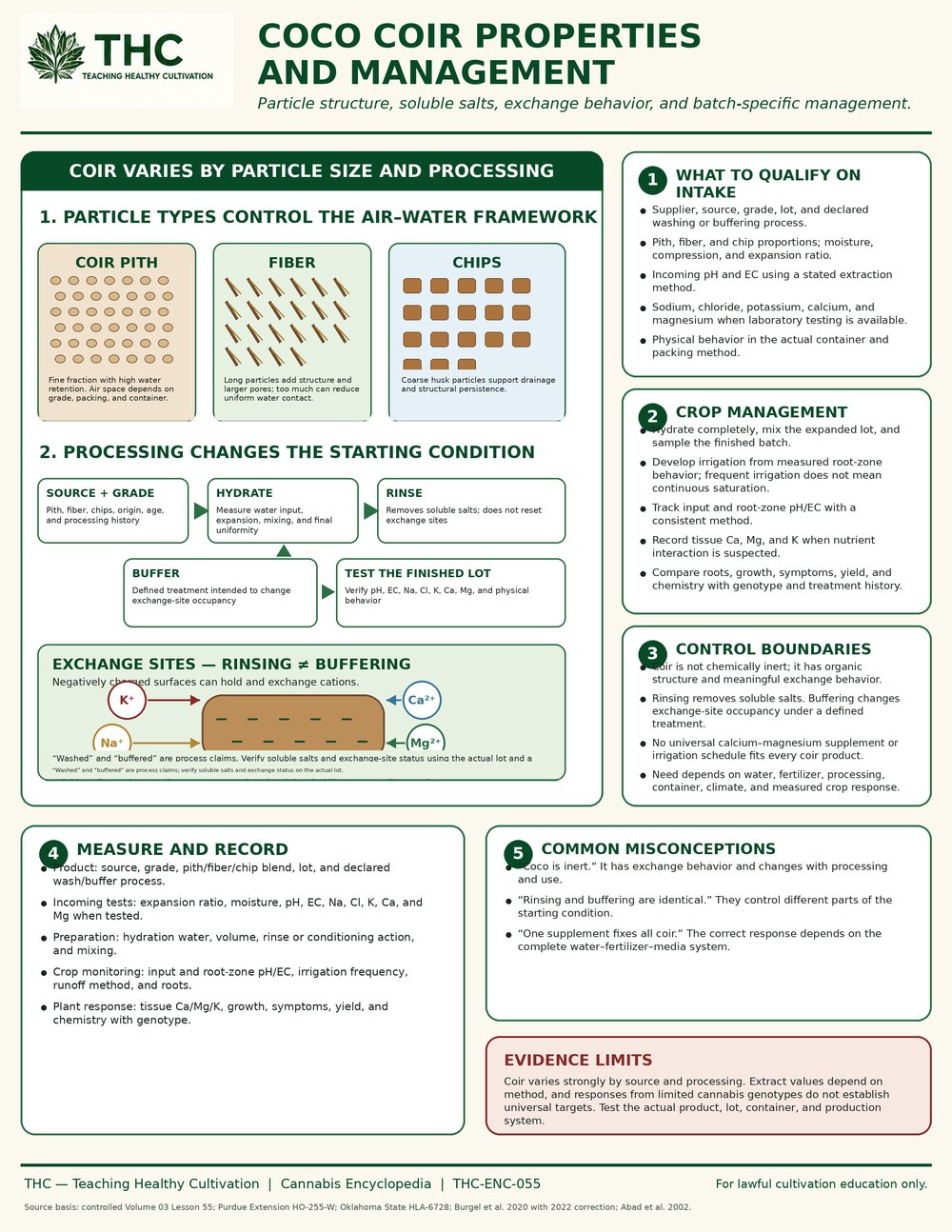
Coir products are made from coconut husks and may contain pith, fiber, chips, or blends. Particle distribution controls water retention and aeration. Coir is generally easier to rewet than dry peat, but air-water behavior still depends on processing, compaction, container, and irrigation.
Coir can contain substantial potassium, sodium, and chloride if processing and washing are inadequate. Its exchange sites interact with calcium, magnesium, potassium, and sodium. ‘Buffered’ is a processing claim that should be supported by supplier quality data and incoming pH/EC or laboratory testing.
A cannabis pot study comparing peat, a peat/green-fiber blend, and coir in two genotypes found substrate- and genotype-dependent effects on biomass, roots, floral yield, and cannabinoid measures. It is evidence that substrate matters, not proof that one category wins in every system.
A substrate’s measured electrical conductivity reflects soluble ions in the chosen extract, not a direct assay of every exchangeable nutrient held on coir surfaces. Likewise, one runoff measurement blends irrigation history, preferential flow, and current pore-water chemistry; it cannot establish a complete calcium or magnesium balance. To compare batches, hold extraction method, sample volume, water quality, and equilibration time constant. If a grower changes nutrient formulation at the same time as replacing coir, that comparison cannot isolate substrate chemistry as the cause of a changed plant response.
Why this matters in cultivation
- Hydrate compressed blocks with measured water, account for expansion, mix completely, and sample the finished lot rather than only the runoff from the first container.
- Develop irrigation and nutrition from measured root-zone behavior. Coir’s frequent-irrigation reputation does not mean roots should remain continuously saturated or that runoff targets can be copied blindly.
- For a controlled comparison, prepare two matched containers with the same crop age and irrigation water, but document the coir lot and buffering history separately. Track irrigation input and runoff EC and pH over several events rather than interpreting one number as proof of a nutrient shortage. If root growth differs, check wetting uniformity and salt accumulation before attributing the response to calcium or magnesium exchange alone.
Measure and record
Product
Source, grade, pith/fiber/chip blend, lot, declared wash/buffer process.
Incoming tests
Expansion ratio, moisture, pH, EC, Na, Cl, K, Ca, and Mg when tested.
Preparation
Hydration water, volume, rinse or conditioning action, and mixing.
Crop monitoring
Input and root-zone pH/EC, irrigation frequency, runoff method, and roots.
Plant response
Tissue Ca/Mg/K, growth, symptoms, yield, and chemistry with genotype.
Comparative evidence protocol
When sampling coir, collect representative subsamples across the delivered lot rather than selecting only material from a wet surface or one pot. Document the laboratory extraction protocol, sample handling time, replicate count, result units, and the water used for extraction so apparent changes can be compared reproducibly.
Common misconceptions
Misconception: Coco is inert
Correction: It has organic structure and meaningful exchange behavior.
Misconception: Rinsing and buffering are identical
Correction: Rinsing removes soluble salts; buffering changes exchange-site occupancy under a defined treatment.
Misconception: Coco requires one universal calcium-magnesium supplement
Correction: Need depends on water, base fertilizer, processing, exchange status, and tissue response.
Evidence limits and uncertainty
Coir varies strongly by source and processing. Extract values depend on method, and responses from two study genotypes do not establish universal cannabis targets.
Supplier buffering claims and container runoff chemistry are indirect indicators; neither alone measures exchange-site saturation or identifies the cause of a crop symptom. A controlled comparison still needs matched genotypes, environments, root-zone moisture conditions, and sufficiently replicated observations before inferring a treatment effect.
Check your reasoning
- For "Coco Coir Properties and Management", explain the mechanism behind this objective: Explain coir’s physical and exchange properties and build a batch-specific management plan for salts, calcium, magnesium, and potassium. Which observation or measurement would best test whether that mechanism is operating in the real crop?
- A learner claims, "Coco is inert" Use the lesson’s science and evidence limits to explain why that claim is unreliable, then name one observation or measurement that could separate the competing explanations.
- Applied case — Hydrate compressed blocks with measured water, account for expansion, mix completely, and sample the finished lot rather than only the runoff from the first container. Build a verification plan using the lesson’s record set (Product, Incoming tests, Preparation). What would you compare before and after the action, and what result would make you revise the original interpretation?
Require lesson-specific evidence, not memorized universal targets. Open the rationales after you have written or discussed your own answer.
Answer rationale 1: Mechanism / workflow rationale
- A strong answer should connect the response to the lesson objective: Explain coir’s physical and exchange properties and build a batch-specific management plan for salts, calcium, magnesium, and potassium.
- Coir products are made from coconut husks and may contain pith, fiber, chips, or blends. Particle distribution controls water retention and aeration. Coir is generally easier to rewet than dry peat, but air-water behavior still depends on processing, compaction, container, and irrigation.
- Coir can contain substantial potassium, sodium, and chloride if processing and washing are inadequate. Its exchange sites interact with calcium, magnesium, potassium, and sodium. ‘Buffered’ is a processing claim that should be supported by supplier quality data and incoming pH/EC or laboratory testing.
- The most useful verification evidence includes Product: Source, grade, pith/fiber/chip blend, lot, declared wash/buffer process.
- Keep this limit explicit: Coir varies strongly by source and processing. Extract values depend on method, and responses from two study genotypes do not establish universal cannabis targets.
Answer rationale 2: Misconception rationale
- The shortcut is unreliable because the lesson explicitly teaches a more conditional explanation.
- Representative misconception: Coco is inert: It has organic structure and meaningful exchange behavior.
- Coir products are made from coconut husks and may contain pith, fiber, chips, or blends. Particle distribution controls water retention and aeration. Coir is generally easier to rewet than dry peat, but air-water behavior still depends on processing, compaction, container, and irrigation.
- A useful discriminator is Incoming tests: Expansion ratio, moisture, pH, EC, Na, Cl, K, Ca, and Mg when tested.
- Do not overextend the conclusion beyond this limit: Coir varies strongly by source and processing. Extract values depend on method, and responses from two study genotypes do not establish universal cannabis targets.
Answer rationale 3: Applied verification rationale
- In practice: Hydrate compressed blocks with measured water, account for expansion, mix completely, and sample the finished lot rather than only the runoff from the first container.
- Record before action: Product: Source, grade, pith/fiber/chip blend, lot, declared wash/buffer process.
- Also record: Incoming tests: Expansion ratio, moisture, pH, EC, Na, Cl, K, Ca, and Mg when tested.
- After the action, repeat the same measurement or observation so the comparison is valid.
- Revise the interpretation if the result conflicts with the lesson limit or the expected response: Coir varies strongly by source and processing. Extract values depend on method, and responses from two study genotypes do not establish universal cannabis targets.
Related lessons
Sources and evidence
- Burgel L, Hartung J, Graeff-Hönninger S. Impact of Different Growing Substrates on Growth, Yield and Cannabinoid Content of Two Cannabis sativa L. Genotypes in a Pot Culture. Horticulturae. 2020;6(4):62. doi:10.3390/horticulturae6040062. See the 2022 correction: doi:10.3390/horticulturae8040298. Open source
- Owen WG, Lopez RG. Commercial Greenhouse and Nursery Production: Evaluating Container Substrates and Their Components. Purdue Extension HO-255-W. 2015. Open source
- Thakulla D, Dunn B, Hu B. Soilless Growing Mediums. Oklahoma State University Extension HLA-6728. 2021. Open source
- Abad M, Noguera P, Puchades R, Maquieira A, Noguera V. Physico-chemical and chemical properties of some coconut coir dusts for use as a peat substitute for containerised ornamental plants. Bioresource Technology. 2002;82(3):241–245. doi:10.1016/S0960-8524(01)00189-4. Abstract available
Downloads
No lesson-specific download is approved for this release. Use browser print/save-to-PDF when you need an offline reading copy.