Peat-Based Substrates
Evaluate peat as a variable horticultural material and manage its acidity, wetting, particle structure, and decomposition.
Evaluate peat as a variable horticultural material and manage its acidity, wetting, particle structure, and decomposition.
Core science
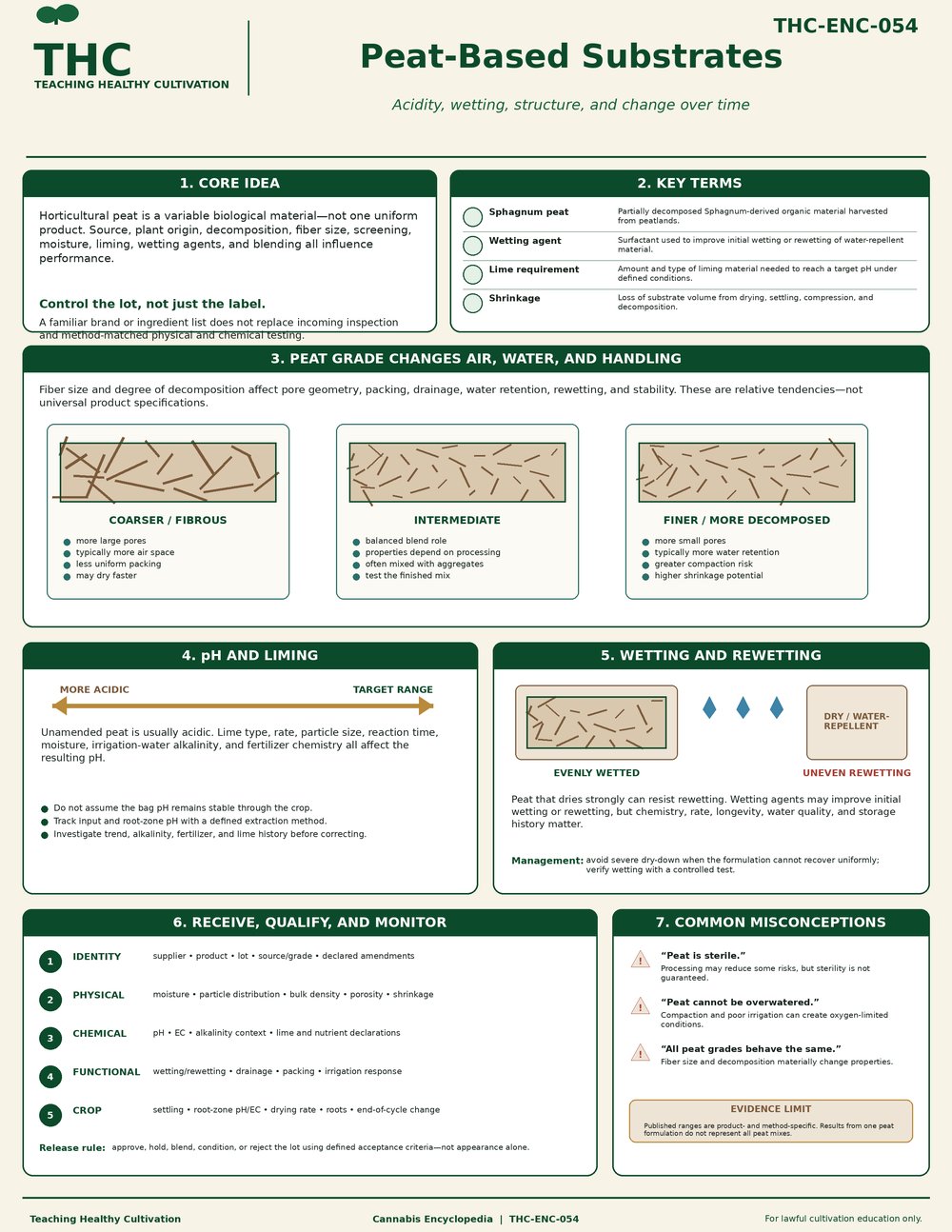
Peat is lightweight, porous, water retentive, and chemically adjustable, which explains its long use in container horticulture. It is not one uniform input. Botanical source, decomposition, fiber size, screening, moisture, and compression affect air space, water retention, and handling.
Unamended Sphagnum peat is acidic and usually receives limestone plus nutrients in commercial mixes. It can become hydrophobic when excessively dry, causing channeling between the root ball and container wall. Wetting agents improve distribution but their effectiveness and persistence vary.
Peat particles settle and decompose over time. Irrigation, microbial activity, compaction, and crop duration can shift the balance toward greater water retention and lower aeration. Sustainability assessment should consider source, restoration practices, transportation, alternatives, and performance rather than relying on a single slogan.
Why this matters in cultivation
- Qualify each mix by lot. Record initial pH/EC, physical properties, wetting time, rewetting after drying, and crop response before scaling.
- Do not transplant a dry peat plug into a wet surrounding mix and assume the center will rehydrate. Verify moisture continuity through the full root ball.
Measure and record
Product
Brand/formulation, lot, peat grade, listed amendments, and manufacture date.
Initial tests
pH, EC, physical properties, moisture, and wetting behavior.
Preparation
Fluffing, premoistening, wetting agent, packing, and container.
Crop monitoring
Mass/water content, shrinkage, channeling, pH/EC trend, and roots.
Disposition
End-of-cycle condition, contamination, reuse decision, and waste route.
Common misconceptions
Misconception: Peat is sterile
Correction: Commercial processing lowers some risks but does not guarantee sterility.
Misconception: Peat cannot be overwatered
Correction: Its pore structure can remain oxygen-limited under poor irrigation or compaction.
Misconception: All peat grades behave the same
Correction: Fiber size and decomposition materially change physical properties.
Evidence limits and uncertainty
Published property ranges are product- and method-specific. Cannabis responses from one peat formulation should not be generalized to all peat mixes.
Check your reasoning
- For "Peat-Based Substrates", explain the mechanism behind this objective: Evaluate peat as a variable horticultural material and manage its acidity, wetting, particle structure, and decomposition. Which observation or measurement would best test whether that mechanism is operating in the real crop?
- A learner claims, "Peat is sterile" Use the lesson’s science and evidence limits to explain why that claim is unreliable, then name one observation or measurement that could separate the competing explanations.
- Applied case — Qualify each mix by lot. Record initial pH/EC, physical properties, wetting time, rewetting after drying, and crop response before scaling. Build a verification plan using the lesson’s record set (Product, Initial tests, Preparation). What would you compare before and after the action, and what result would make you revise the original interpretation?
Require lesson-specific evidence, not memorized universal targets. Open the rationales after you have written or discussed your own answer.
Answer rationale 1: Mechanism / workflow rationale
- A strong answer should connect the response to the lesson objective: Evaluate peat as a variable horticultural material and manage its acidity, wetting, particle structure, and decomposition.
- Peat is lightweight, porous, water retentive, and chemically adjustable, which explains its long use in container horticulture. It is not one uniform input. Botanical source, decomposition, fiber size, screening, moisture, and compression affect air space, water retention, and handling.
- Unamended Sphagnum peat is acidic and usually receives limestone plus nutrients in commercial mixes. It can become hydrophobic when excessively dry, causing channeling between the root ball and container wall. Wetting agents improve distribution but their effectiveness and persistence vary.
- The most useful verification evidence includes Product: Brand/formulation, lot, peat grade, listed amendments, and manufacture date.
- Keep this limit explicit: Published property ranges are product- and method-specific. Cannabis responses from one peat formulation should not be generalized to all peat mixes.
Answer rationale 2: Misconception rationale
- The shortcut is unreliable because the lesson explicitly teaches a more conditional explanation.
- Representative misconception: Peat is sterile: Commercial processing lowers some risks but does not guarantee sterility.
- Peat is lightweight, porous, water retentive, and chemically adjustable, which explains its long use in container horticulture. It is not one uniform input. Botanical source, decomposition, fiber size, screening, moisture, and compression affect air space, water retention, and handling.
- A useful discriminator is Initial tests: pH, EC, physical properties, moisture, and wetting behavior.
- Do not overextend the conclusion beyond this limit: Published property ranges are product- and method-specific. Cannabis responses from one peat formulation should not be generalized to all peat mixes.
Answer rationale 3: Applied verification rationale
- In practice: Qualify each mix by lot. Record initial pH/EC, physical properties, wetting time, rewetting after drying, and crop response before scaling.
- Record before action: Product: Brand/formulation, lot, peat grade, listed amendments, and manufacture date.
- Also record: Initial tests: pH, EC, physical properties, moisture, and wetting behavior.
- After the action, repeat the same measurement or observation so the comparison is valid.
- Revise the interpretation if the result conflicts with the lesson limit or the expected response: Published property ranges are product- and method-specific. Cannabis responses from one peat formulation should not be generalized to all peat mixes.
Related lessons
Sources and evidence
- Owen WG, Lopez RG. Commercial Greenhouse and Nursery Production: Evaluating Container Substrates and Their Components. Purdue Extension HO-255-W. 2015. Open source
- Burgel L, Hartung J, Graeff-Hönninger S. Impact of Different Growing Substrates on Growth, Yield and Cannabinoid Content of Two Cannabis sativa L. Genotypes in a Pot Culture. Horticulturae. 2020;6(4):62. doi:10.3390/horticulturae6040062. See the 2022 correction: doi:10.3390/horticulturae8040298. Open source
- THC – Teaching Healthy Cultivation. Cannabis Plant Science Source Packet, version 1. Project source packet supplied by the publisher.
- Oklahoma State University Extension. Containers and Media for the Nursery. Extension guidance on peat wettability, media components, and material limitations. Open source
- Thakulla D, Dunn B, Hu B. Soilless Growing Mediums. Oklahoma State University Extension HLA-6728. 2021. Open source
Downloads
No lesson-specific download is approved for this release. Use browser print/save-to-PDF when you need an offline reading copy.