Root Exudates and Rhizosphere Signaling
Describe root exudates as dynamic carbon and signaling flows without turning them into unsupported claims about guaranteed microbial benefits.
Describe root exudates as dynamic carbon and signaling flows without turning them into unsupported claims about guaranteed microbial benefits.
Core science
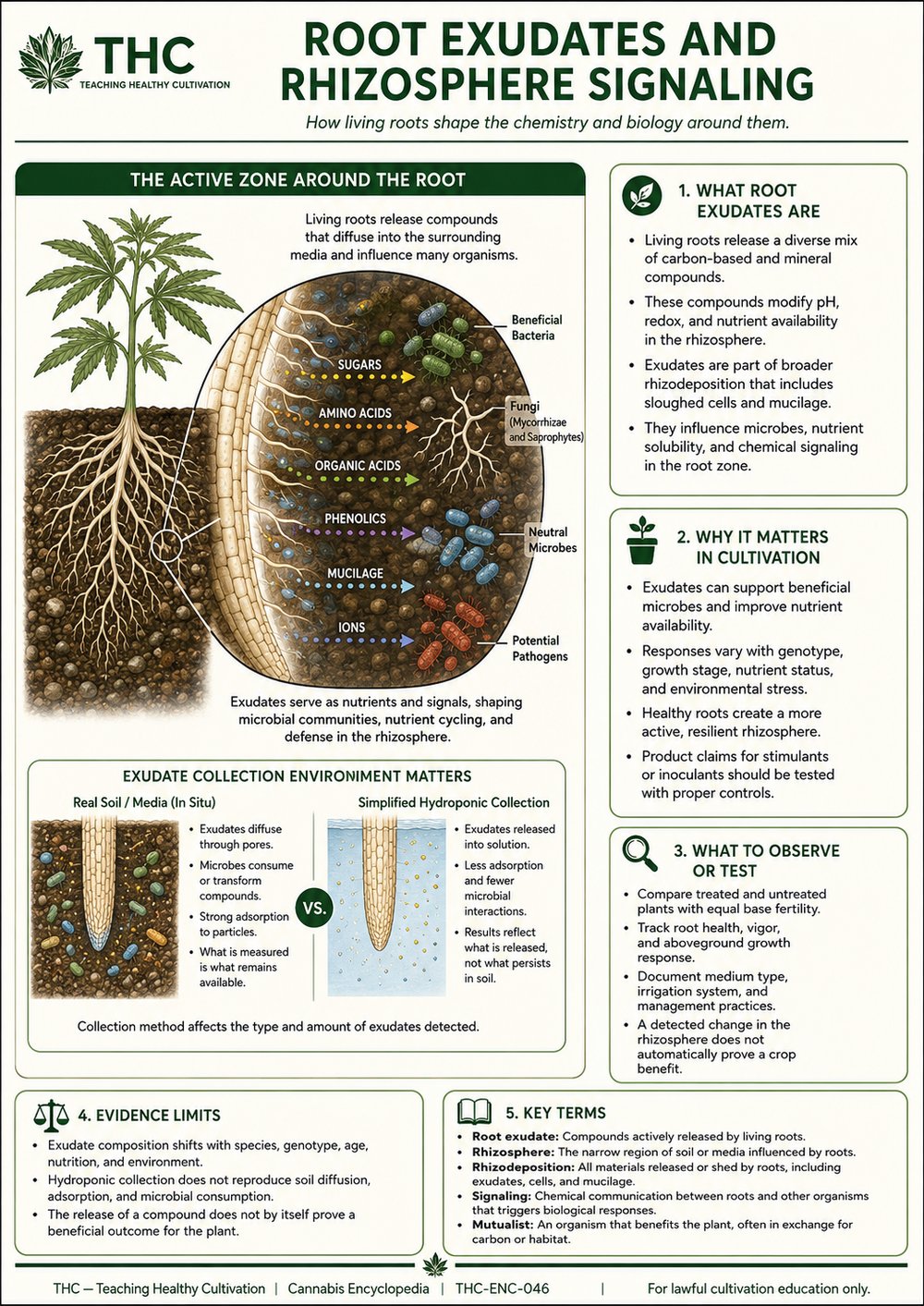
Roots release sugars, amino acids, organic acids, phenolics, ions, mucilage, enzymes, and many other compounds. Some release is passive; some is regulated transport; some material comes from border cells or damaged tissues. The mixture changes with plant age, nutrient status, light, stress, genotype, and root-zone conditions.
These compounds alter pH and mineral availability, feed microorganisms, and create chemical signals. Microbes can move toward, consume, transform, or compete for exudates. Pathogens can also exploit root-derived resources. ‘Feeding the soil food web’ is therefore a partial description, not proof of a favorable outcome.
Exudation is difficult to measure without disturbing roots or changing the chemical environment. Hydroponic collection can simplify sampling but may not reproduce diffusion, sorption, and microbial consumption in soil or organic media.
Why this matters in cultivation
- Avoid diagnosing exudation from smell, foam, or biofilm alone. Those observations can arise from microbes, fertilizers, decaying roots, additives, or system contamination.
- When evaluating inoculants or carbon additives, use treated and untreated groups, equal fertility, defined organisms, root-health observations, and a meaningful production endpoint.
Measure and record
Plant context
Genotype, age, stage, photosynthetic environment, and stress history.
Root environment
Media, temperature, oxygen, pH, EC, moisture, and organic inputs.
Treatment
Product organism or ingredient, lot, rate, timing, and untreated comparison.
Microbial evidence
Culture, microscopy, sequencing, or laboratory test if performed.
Outcome
Root mass, colonization, disease incidence, biomass, and chemistry with method.
Common misconceptions
Misconception: All exudates are beneficial
Correction: They may support mutualists, neutral organisms, competitors, or pathogens.
Misconception: Sugar added to media is equivalent to natural exudation
Correction: Location, rate, chemistry, and regulation differ.
Misconception: Visible biofilm proves productive signaling
Correction: Biofilm identity and effect require evidence.
Evidence limits and uncertainty
Most mechanistic detail comes from non-cannabis plants. Cannabis root-exudate profiles and their production-scale consequences are still undercharacterized.
Check your reasoning
- For "Root Exudates and Rhizosphere Signaling", explain the mechanism behind this objective: Describe root exudates as dynamic carbon and signaling flows without turning them into unsupported claims about guaranteed microbial benefits. Which observation or measurement would best test whether that mechanism is operating in the real crop?
- A learner claims, "All exudates are beneficial" Use the lesson’s science and evidence limits to explain why that claim is unreliable, then name one observation or measurement that could separate the competing explanations.
- Applied case — Avoid diagnosing exudation from smell, foam, or biofilm alone. Those observations can arise from microbes, fertilizers, decaying roots, additives, or system contamination. Build a verification plan using the lesson’s record set (Plant context, Root environment, Treatment). What would you compare before and after the action, and what result would make you revise the original interpretation?
Require lesson-specific evidence, not memorized universal targets. Open the rationales after you have written or discussed your own answer.
Answer rationale 1: Mechanism / workflow rationale
- A strong answer should connect the response to the lesson objective: Describe root exudates as dynamic carbon and signaling flows without turning them into unsupported claims about guaranteed microbial benefits.
- Roots release sugars, amino acids, organic acids, phenolics, ions, mucilage, enzymes, and many other compounds. Some release is passive; some is regulated transport; some material comes from border cells or damaged tissues. The mixture changes with plant age, nutrient status, light, stress, genotype, and root-zone conditions.
- These compounds alter pH and mineral availability, feed microorganisms, and create chemical signals. Microbes can move toward, consume, transform, or compete for exudates. Pathogens can also exploit root-derived resources. ‘Feeding the soil food web’ is therefore a partial description, not proof of a favorable outcome.
- The most useful verification evidence includes Plant context: Genotype, age, stage, photosynthetic environment, and stress history.
- Keep this limit explicit: Most mechanistic detail comes from non-cannabis plants. Cannabis root-exudate profiles and their production-scale consequences are still undercharacterized.
Answer rationale 2: Misconception rationale
- The shortcut is unreliable because the lesson explicitly teaches a more conditional explanation.
- Representative misconception: All exudates are beneficial: They may support mutualists, neutral organisms, competitors, or pathogens.
- Roots release sugars, amino acids, organic acids, phenolics, ions, mucilage, enzymes, and many other compounds. Some release is passive; some is regulated transport; some material comes from border cells or damaged tissues. The mixture changes with plant age, nutrient status, light, stress, genotype, and root-zone conditions.
- A useful discriminator is Root environment: Media, temperature, oxygen, pH, EC, moisture, and organic inputs.
- Do not overextend the conclusion beyond this limit: Most mechanistic detail comes from non-cannabis plants. Cannabis root-exudate profiles and their production-scale consequences are still undercharacterized.
Answer rationale 3: Applied verification rationale
- In practice: Avoid diagnosing exudation from smell, foam, or biofilm alone. Those observations can arise from microbes, fertilizers, decaying roots, additives, or system contamination.
- Record before action: Plant context: Genotype, age, stage, photosynthetic environment, and stress history.
- Also record: Root environment: Media, temperature, oxygen, pH, EC, moisture, and organic inputs.
- After the action, repeat the same measurement or observation so the comparison is valid.
- Revise the interpretation if the result conflicts with the lesson limit or the expected response: Most mechanistic detail comes from non-cannabis plants. Cannabis root-exudate profiles and their production-scale consequences are still undercharacterized.
Related lessons
Sources and evidence
- Enagbonma BJ, Fadiji AE, Ayangbenro AS, Babalola OO. Communication between Plants and Rhizosphere Microbiome: Exploring the Root Microbiome for Sustainable Agriculture. Microorganisms. 2023;11(8):2003. doi:10.3390/microorganisms11082003. Open source
- Ahmed B, Hijri M. Potential impacts of soil microbiota manipulation on secondary metabolites production in cannabis. Journal of Cannabis Research. 2021;3:25. doi:10.1186/s42238-021-00082-0. Open source
- Suwanchaikasem P, Idnurm A, Selby-Pham J, et al. Root-TRAPR: a modular plant growth device to visualize root development and monitor growth parameters, as applied to an elicitor response of Cannabis sativa. Plant Methods. 2022;18:46. doi:10.1186/s13007-022-00875-1. Open source
Downloads
No lesson-specific download is approved for this release. Use browser print/save-to-PDF when you need an offline reading copy.