Lateral Roots, Root Hairs, and Functional Surface Area
Distinguish root-system architecture from root-hair surface and use both concepts when evaluating establishment and uptake capacity.
Distinguish root-system architecture from root-hair surface and use both concepts when evaluating establishment and uptake capacity.
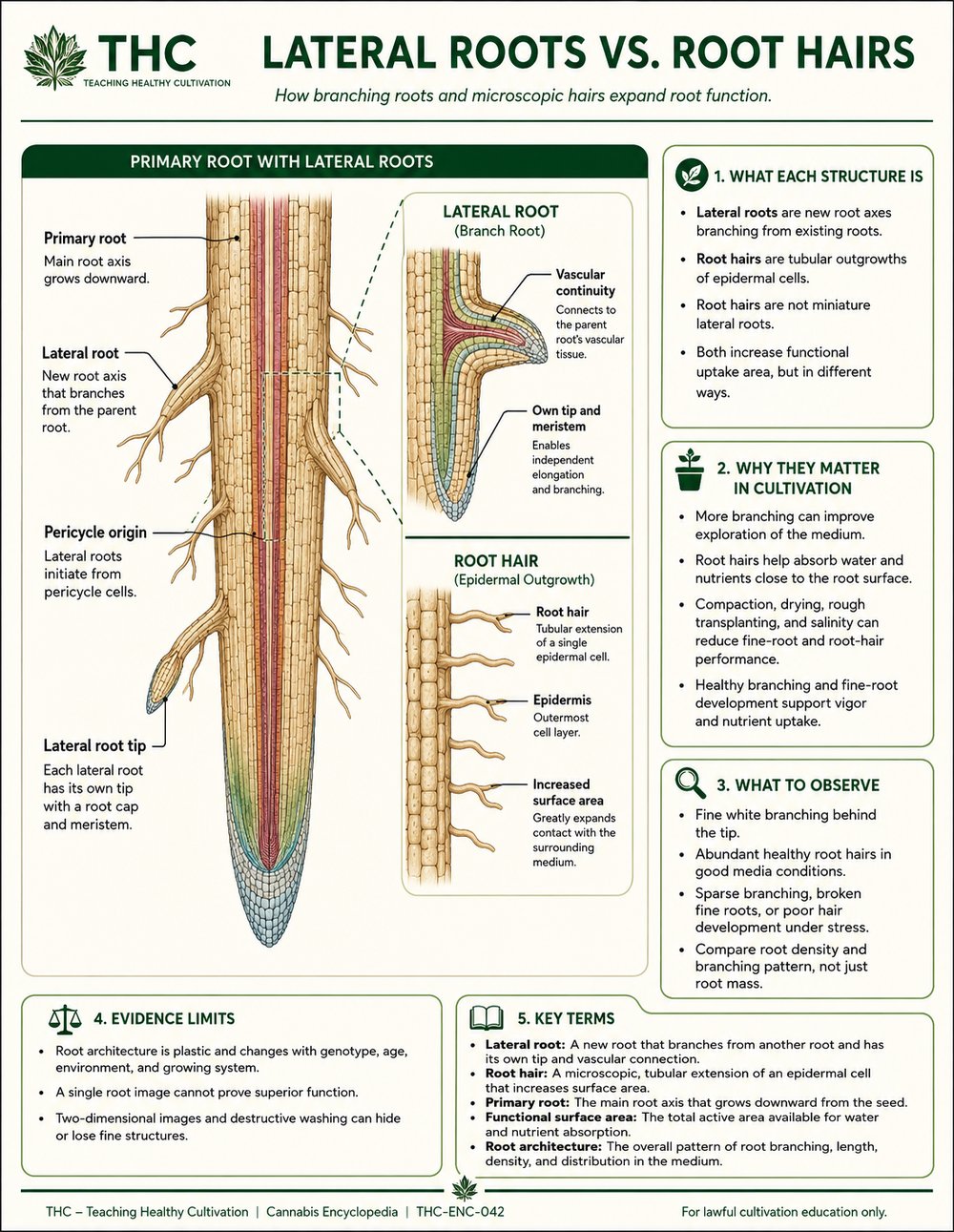
Core science
Lateral roots add new axes that explore additional media volume. Root hairs extend from epidermal cells in a differentiated region behind growing tips and greatly increase contact with water films, ions, particles, and microbes. Lateral roots contain multiple tissues; a root hair is a single-cell extension. Confusing them leads to poor observation and misleading diagrams.
Architecture is plastic. Water distribution, local nutrient supply, mechanical resistance, oxygen, hormones, and genotype affect branching and elongation. A root system can have substantial mass but low exploration efficiency, or fine roots with high length per mass but limited total volume. No single photograph proves superior root function.
Industrial-hemp data demonstrate meaningful genetic diversity in architecture and root-to-shoot allocation. Those findings support breeding and phenotyping, but values from field hemp cannot be transferred directly to compact indoor drug-type plants in containers.
Why this matters in cultivation
- Uniform irrigation matters because roots proliferate where water, oxygen, and usable nutrients repeatedly coexist. Persistent dry pockets and saturated pockets divide the container into usable and unusable volumes.
- Root hairs are easily destroyed by drying, salinity, pathogens, and rough washing. Use consistent sampling and gentle imaging if root comparisons matter.
Measure and record
Architecture
Maximum depth, horizontal spread, total root length if measured, and branching pattern.
Root fineness
Representative diameter classes or specific root length when laboratory tools are available.
Container
Shape, height, volume, drainage pattern, and root-bound observations.
Distribution
Wet/dry zones, emitter position, and visual colonization by sector.
Shoot context
Leaf area, biomass, growth stage, and root-to-shoot ratio if destructively sampled.
Common misconceptions
Misconception: Root hairs are tiny roots
Correction: They are extensions of epidermal cells and have a different developmental origin.
Misconception: More visible roots always mean more uptake
Correction: Activity depends on age, contact, oxygen, water status, and membrane function.
Misconception: One root shape defines cannabis
Correction: Cannabis root architecture varies with genotype and environment.
Evidence limits and uncertainty
Destructive washing can lose fine roots, and two-dimensional images reduce a three-dimensional system to a limited projection. Destructive sampling also prevents repeated measurement of the same plant, so method and recovery efficiency must accompany comparisons.
Check your reasoning
- For "Lateral Roots, Root Hairs, and Functional Surface Area", explain the mechanism behind this objective: Distinguish root-system architecture from root-hair surface and use both concepts when evaluating establishment and uptake capacity. Which observation or measurement would best test whether that mechanism is operating in the real crop?
- A learner claims, "Root hairs are tiny roots" Use the lesson’s science and evidence limits to explain why that claim is unreliable, then name one observation or measurement that could separate the competing explanations.
- Applied case — Uniform irrigation matters because roots proliferate where water, oxygen, and usable nutrients repeatedly coexist. Persistent dry pockets and saturated pockets divide the container into usable and unusable volumes. Build a verification plan using the lesson’s record set (Architecture, Root fineness, Container). What would you compare before and after the action, and what result would make you revise the original interpretation?
Require lesson-specific evidence, not memorized universal targets. Open the rationales after you have written or discussed your own answer.
Answer rationale 1: Mechanism / workflow rationale
- A strong answer should connect the response to the lesson objective: Distinguish root-system architecture from root-hair surface and use both concepts when evaluating establishment and uptake capacity.
- Lateral roots add new axes that explore additional media volume. Root hairs extend from epidermal cells in a differentiated region behind growing tips and greatly increase contact with water films, ions, particles, and microbes. Lateral roots contain multiple tissues; a root hair is a single-cell extension. Confusing them leads to poor observation and misleading diagrams.
- Architecture is plastic. Water distribution, local nutrient supply, mechanical resistance, oxygen, hormones, and genotype affect branching and elongation. A root system can have substantial mass but low exploration efficiency, or fine roots with high length per mass but limited total volume. No single photograph proves superior root function.
- The most useful verification evidence includes Architecture: Maximum depth, horizontal spread, total root length if measured, and branching pattern.
- Keep this limit explicit: Destructive washing can lose fine roots, and two-dimensional images reduce a three-dimensional system to a limited projection. Destructive sampling also prevents repeated measurement of the same plant, so method and recovery efficiency must accompany comparisons.
Answer rationale 2: Misconception rationale
- The shortcut is unreliable because the lesson explicitly teaches a more conditional explanation.
- Representative misconception: Root hairs are tiny roots: They are extensions of epidermal cells and have a different developmental origin.
- Lateral roots add new axes that explore additional media volume. Root hairs extend from epidermal cells in a differentiated region behind growing tips and greatly increase contact with water films, ions, particles, and microbes. Lateral roots contain multiple tissues; a root hair is a single-cell extension. Confusing them leads to poor observation and misleading diagrams.
- A useful discriminator is Root fineness: Representative diameter classes or specific root length when laboratory tools are available.
- Do not overextend the conclusion beyond this limit: Destructive washing can lose fine roots, and two-dimensional images reduce a three-dimensional system to a limited projection. Destructive sampling also prevents repeated measurement of the same plant, so method and recovery efficiency must accompany comparisons.
Answer rationale 3: Applied verification rationale
- In practice: Uniform irrigation matters because roots proliferate where water, oxygen, and usable nutrients repeatedly coexist. Persistent dry pockets and saturated pockets divide the container into usable and unusable volumes.
- Record before action: Architecture: Maximum depth, horizontal spread, total root length if measured, and branching pattern.
- Also record: Root fineness: Representative diameter classes or specific root length when laboratory tools are available.
- After the action, repeat the same measurement or observation so the comparison is valid.
- Revise the interpretation if the result conflicts with the lesson limit or the expected response: Destructive washing can lose fine roots, and two-dimensional images reduce a three-dimensional system to a limited projection. Destructive sampling also prevents repeated measurement of the same plant, so method and recovery efficiency must accompany comparisons.
Related lessons
Sources and evidence
- Canadian Food Inspection Agency. The Biology of Cannabis sativa L. (Cannabis, hemp, marijuana). 2021.
- Morales EY, et al. Diversity of root system architecture and root-shoot biomass allocation in industrial hemp (Cannabis sativa L.). PLOS ONE. 2026;21(2):e0339929. doi:10.1371/journal.pone.0339929. See the May 7, 2026 correction adding omitted author Tyler G. Dowd: doi:10.1371/journal.pone.0349068. Open source
- Waidmann S, Sarkel E, Kleine-Vehn J. Same same, but different: growth responses of primary and lateral roots. Journal of Experimental Botany. 2020;71(8):2397–2411. doi:10.1093/jxb/eraa027. Open source
- Li A, Zhu L, Xu W, Liu L, Teng G. Recent advances in methods for in situ root phenotyping. PeerJ. 2022;10:e13638. doi:10.7717/peerj.13638. Open source
Downloads
No lesson-specific download is approved for this release. Use browser print/save-to-PDF when you need an offline reading copy.