Integrated Technician Workflow Case
The final lesson combines safety, biosecurity, controlled instructions, traceability, equipment care, records and handoff into one shift-length Technician I simulation. Learners must identify dependencies before acting, preserve blocked or unresolved work, respond to new conditions mid-case, and leave a reconstructable evidence packet for the next shift.
Key vocabulary
The collection of current instructions, assignments, records, identifiers, status information and supporting evidence used to complete a task or shift.
Prioritization of conditions so urgent safety, biosecurity, identity, equipment or process risks are addressed before lower-risk production tasks.
A condition that must be resolved or verified before another task can safely or correctly proceed.
Demonstrating multiple competencies together in a realistic workflow rather than answering isolated knowledge questions.
Read the whole system before acting
Real shifts contain competing priorities and linked controls. A scheduled movement can depend on room status, identity, sanitation, equipment readiness and entry authorization at the same time. The technician first identifies conditions that block downstream work instead of automatically starting the first line on the schedule.
Use evidence to choose the next safe action
Each decision should be tied to controlled information: current instruction, label/SDS and PPE requirements, entry status, physical identifiers, equipment readiness, traceability event history or factual observations. When evidence conflicts or authority ends, the correct performance is to hold, stop or escalate—not improvise.
Finish with a reconstructable shift state
The simulation is complete only when records show what was completed, what changed, what could not be completed, which statuses remain active, who was notified, what evidence supports the final physical/record state and what the incoming shift must do next.
Worked examples
- A planned plant move is delayed because the destination is held and one identifier mismatches; both controls are preserved and routed before movement.
- A sanitation product does not match the controlled instruction, so the learner refuses substitution and uses the contingency/escalation path.
- An equipment alarm receives only permitted external checks and a time-ordered maintenance escalation, not an unauthorized repair.
- A required historical measurement is missing; the learner uses the missing-data/late-entry process rather than inventing a value.
- A work-related symptom pattern is reported factually with task/control context without the technician assigning a medical diagnosis.
- The final handoff leads with active restrictions, unresolved identity/equipment conditions and the next time-sensitive event before routine completed work.
Common mistakes
- Starting the first assigned task before checking dependencies and restrictions.
- Treating documentation as optional because the physical work was completed.
- Resolving identity conflicts by relabeling or choosing the most convenient record.
- Using more PPE as permission to ignore a restricted area, unclear product or unauthorized task.
- Crossing into maintenance because the fault appears simple.
- Forcing every task to 'complete' before shift end instead of preserving honest open status.
- Handing off vague problems without exact identity, owner, next action or cross-check.
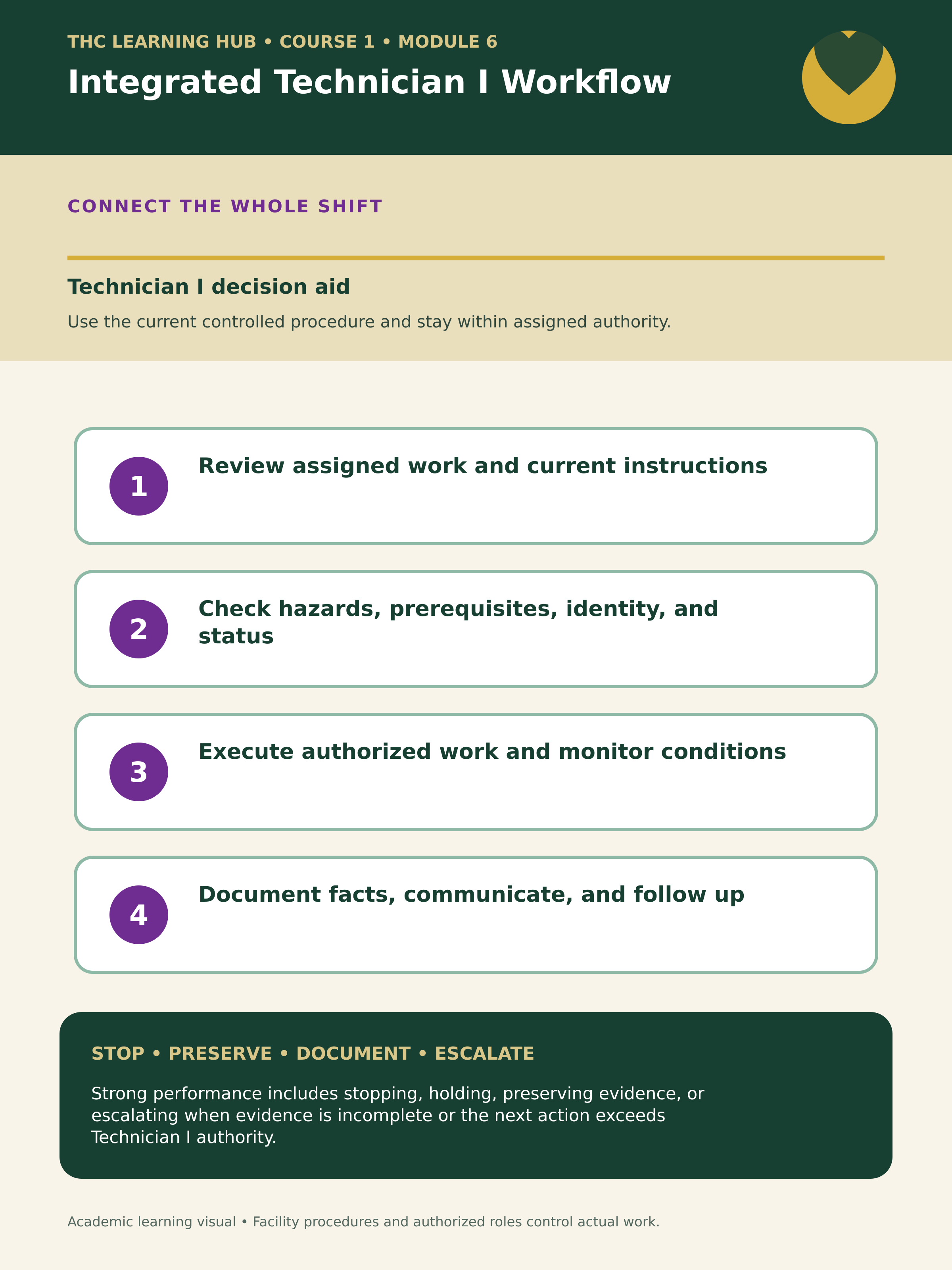
Phase 1 — triage the shift before work begins
Identify holds, quarantine, restricted entry, out-of-service equipment, open deviations, missing records and time-sensitive next actions.
Check hazards, product identity, label/SDS, required PPE and conditions that require stop-work or emergency response.
Confirm current SOP/work orders, scope, prerequisites, acceptance criteria and escalation points.
Match physical identifiers, source/destination, count/quantity and current status before movement/transformation.
Confirm transition controls, approved products and zone status before introducing people, tools or material.
Mark every condition that must be cleared or escalated before another scheduled task can proceed.
Initial work-packet triage
| Condition | What it blocks or changes | Technician I response |
|---|---|---|
| Destination room is on hold | Planned movement cannot close normally | Do not move material; preserve hold and route release decision |
| One source tag does not match movement order | Genealogy may be lost or assigned incorrectly | Stop affected movement and resolve identity before transition |
| Sanitation station lacks approved product | Required biosecurity preparation may not be achievable | Do not substitute; use controlled contingency/escalation |
| Post-application REI is active | Ordinary worker entry remains restricted | Verify status/authorization and do not treat schedule or PPE as clearance |
| Irrigation pump alarm is active | Crop process may be affected; root cause unknown | Capture fault context, perform permitted checks only and use maintenance path |
| Prior-shift measurement is missing | Historical fact cannot be recreated as contemporaneous data | Preserve missing status and use late-entry/missing-data process |
Which issues block the planned plant move?
Setting: At shift start you receive a plant-movement order. The destination room is on hold, one source tag does not match the order, the sanitation station is missing the approved product, and a pump alarm is active elsewhere.
Prompt: What should happen before the move begins?
- Start moving the correctly tagged plants and resolve the rest later
- Clear the destination hold yourself because the movement is scheduled
- Resolve or escalate the hold, identity mismatch and sanitation readiness before beginning the movement; handle the pump only within its separate permitted operator process
- Ignore the sanitation issue because it is unrelated to identity
Check response
Answer: Resolve or escalate the hold, identity mismatch and sanitation readiness before beginning the movement; handle the pump only within its separate permitted operator process.
Several controls independently block or condition the movement. Task order does not override hold status, identity control, biosecurity requirements or equipment authority boundaries.
Phase 2 — execute only authorized routine work
Correct hazards and readiness issues only when the supplied procedure explicitly gives the technician that action.
Use current instructions and preserve the required identifiers and traceability events.
Capture required measurements, movements, checks, exceptions and status changes with enough context to reconstruct them.
Servicing, release decisions, early-entry/handler authority and other higher-authority actions stay with their controlling roles/processes.
Do not manufacture completion simply because the schedule or shift is advancing.
Mid-shift conditions change
Setting: After two routine tasks are completed, a worker reports repeated cough and chest tightness associated with a dusty handling task while the assigned local control is not operating. At the same time, an equipment fault recurs after one permitted reset.
Prompt: What is the strongest integrated response?
- Finish the shift first because neither condition has stopped production completely
- Give the worker any available mask and keep resetting the equipment
- Use the workplace symptom-reporting/safety process and address the failed exposure control without diagnosing the worker; preserve the recurring fault timeline and escalate after permitted checks
- Record both issues as resolved because they were reported
Check response
Answer: Use the workplace symptom-reporting/safety process and address the failed exposure control without diagnosing the worker; preserve the recurring fault timeline and escalate after permitted checks.
Integrated performance keeps safety, equipment authority and record integrity separate while responding to both changing conditions.
Phase 3 — reconcile physical and recorded reality
Confirm controlled identifiers and physical locations agree after movement or status changes.
Compare physical and recorded state without forcing a balance when evidence disagrees.
Confirm new identifiers created by movement/transformation remain linked to source identities and events.
Acceptance criteria and required records must be complete; otherwise preserve open/incomplete status.
Make unresolved identity, equipment, sanitation, entry or record issues visible to the receiving role.
Integrated performance versus task-completion only
Integrated performance
Checks dependencies first, follows current instructions, protects identity, works within authority, records facts as they occur, reconciles physical/record status and hands off unresolved conditions.
Task-completion only
Focuses on finishing visible physical tasks even when controls conflict, documentation is incomplete, identity is uncertain or the next action exceeds authorization.
Integrated capstone evidence packet
The learner should leave a reconstructable trail showing both completed work and intentionally unresolved work.
A capstone answer is not stronger because everything is marked complete. It is stronger when the final records accurately distinguish completed work from work still requiring authorized action.
Phase 4 — transfer the shift
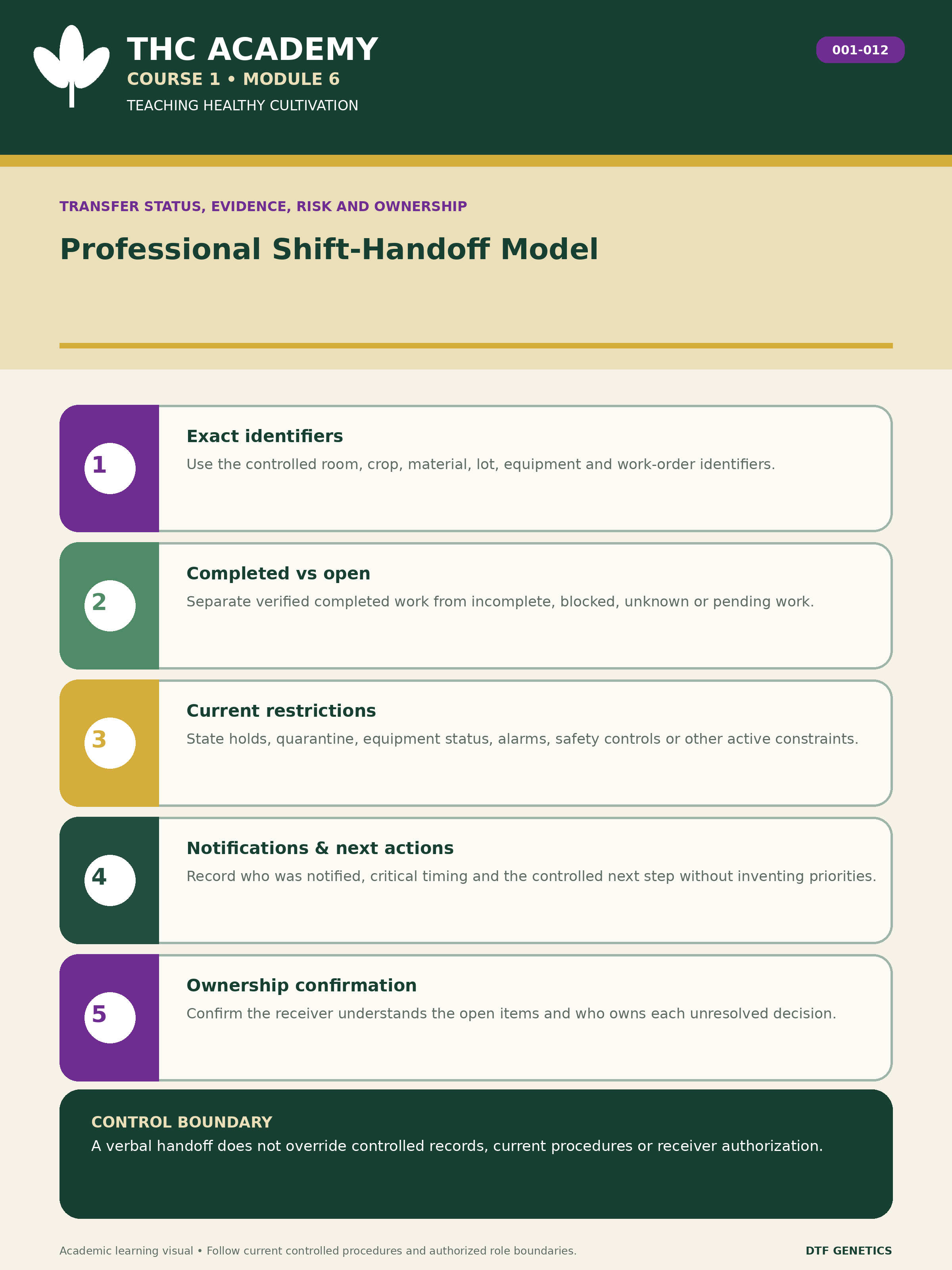
Prioritize active restrictions, holds, out-of-service assets, discrepancies and incomplete work.
Use exact identifiers, observations, status, notifications, next actions and timing.
Verify critical status against supplied records, tags, displays or physical condition.
Incoming worker confirms the highest-risk open items and who owns the next action.
Complete the integrated Technician I shift simulation
Use the supplied work packet as if starting a real shift. The case introduces new information after the initial plan, so decisions must be updated without losing control of earlier work.
Practical application
Complete the integrated case in four phases: triage the initial work packet, execute only authorized routine work, respond to new mid-shift conditions, and close the shift with physical/record reconciliation plus a two-way-ready handoff. Produce a complete evidence packet showing every decision and unresolved dependency.
Lesson summary
Course 1 culminates in integrated operational judgment: work safely, protect biosecurity and identity, follow current controlled instructions, stay within authority, create trustworthy records, reconcile reality with records and transfer unresolved work clearly to the next responsible person.